

CHAPTER 4
The Transition to Digital: Early Experiments by Kodak, Canon, Nikon and Olympus (1998–2003)
The late 1990s and early 2000s marked a period in which digital photography had already demonstrated potential, yet was not capable of fully replacing film within the professional environment.
One of the most visible participants in this transitional phase was Kodak, which actively promoted its own digital SLR cameras for the professional market in the late 1990s. At the time, Kodak’s digital reportage cameras were hybrid solutions built on the bodies of professional film cameras from Canon and Nikon. In particular, the Kodak DCS 520C and Kodak DCS 560C were produced using the body of the Canon EOS-1N — Canon’s flagship film camera introduced in 1994 — and utilised the Canon EF mount.
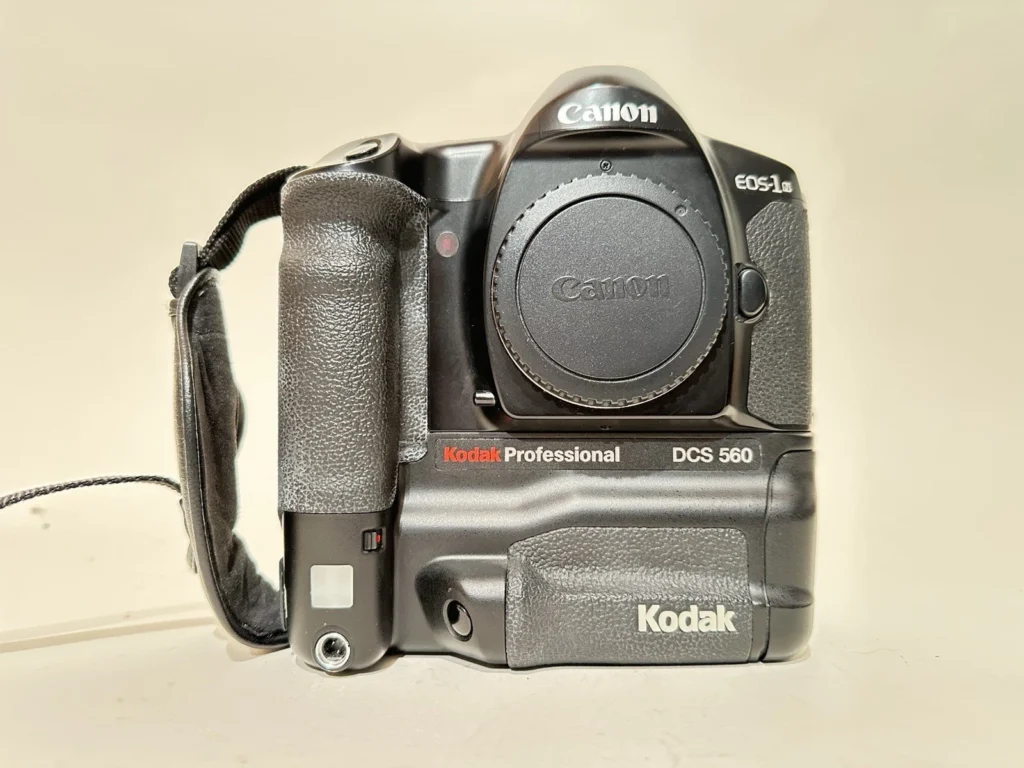
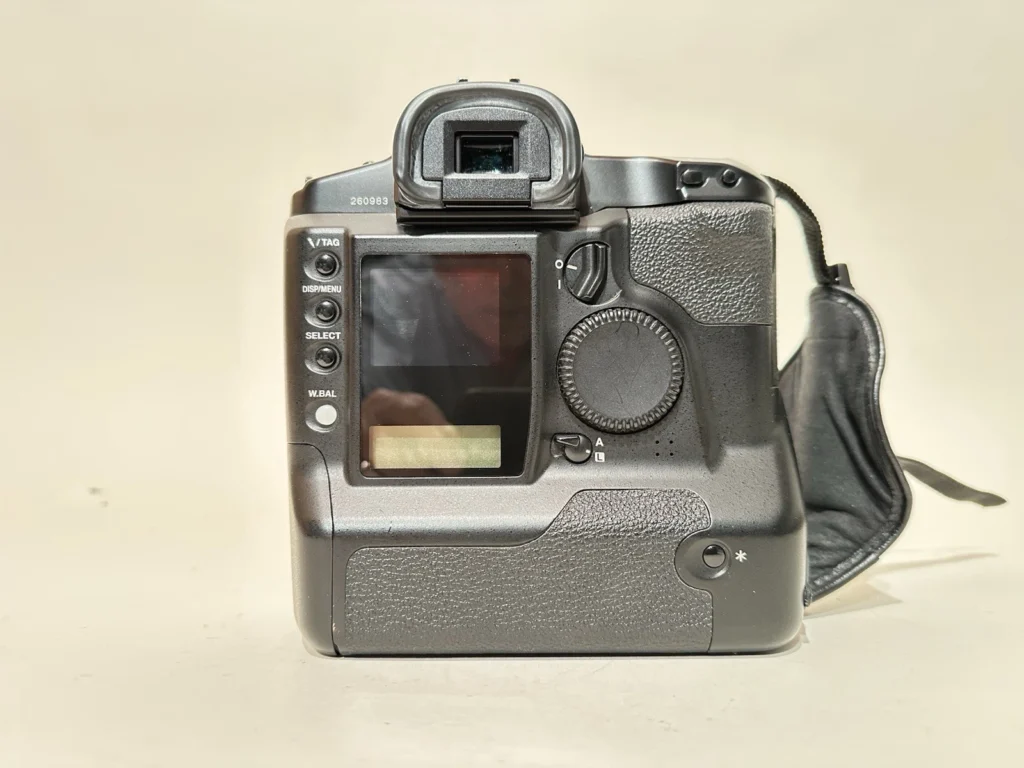
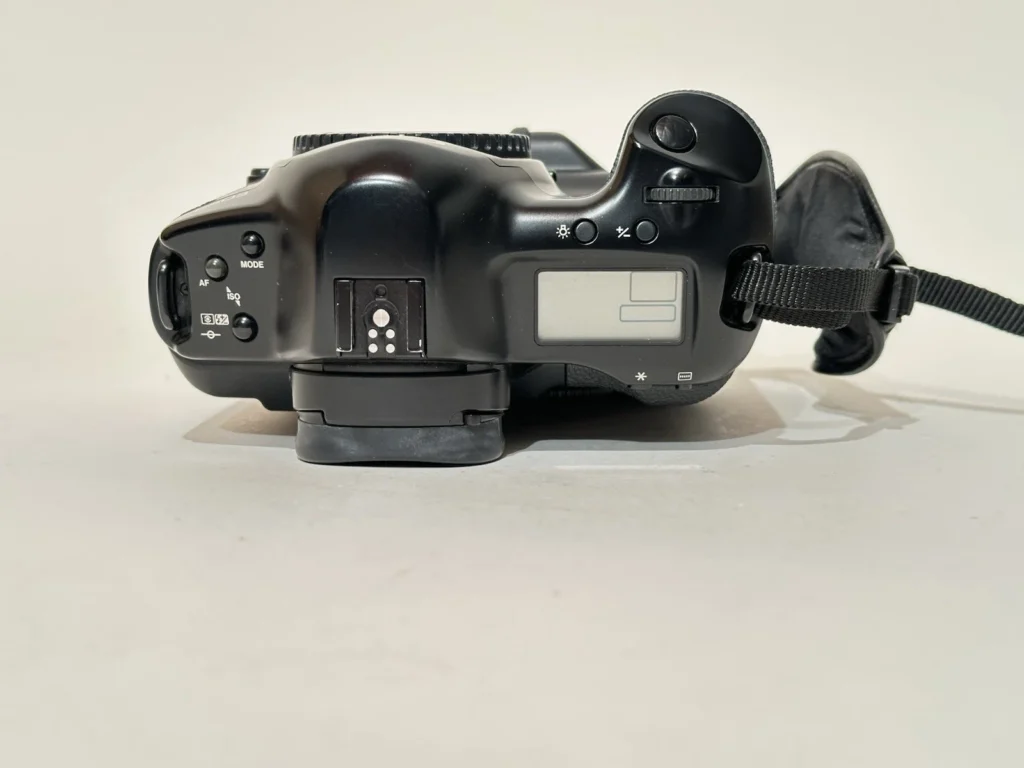
Technically, these cameras were equipped with APS-H format CCD sensors measuring approximately 27.4 × 18.1 mm, with a crop factor of 1.3×, a resolution of around 6 megapixels and 12-bit colour depth. Images were recorded in Kodak’s proprietary RAW (TIFF-based) format at a resolution of 3040 × 2008 pixels. Continuous shooting speed was approximately one frame per second — insufficient by the standards of most professional film cameras of the time, let alone the demands of motor racing photography. Nevertheless, Kodak systems were among the first digital tools to see regular use in Formula 1.
The gallery was not found!During the 2001 season, a significant number of official images of Scuderia Ferrari — then driven by Michael Schumacher and Rubens Barrichello — were captured using Kodak digital cameras. Despite their evident technical limitations, these systems allowed for rapid image transmission to editorial offices and agencies, a factor that was becoming increasingly important in the production of sports content.
Kodak cameras were also used in work with Toyota F1 during preparations for the team’s Formula 1 debut. In January 2002, photographic coverage of testing for the Toyota TF102 at the Circuit de Catalunya near Barcelona was carried out using the Kodak DCS 560C. These tests became a clear example of digital photography’s early penetration into Formula 1, and the resulting images have survived online to this day.
The gallery was not found!Working with Kodak cameras demanded discipline and precise timing from photographers. Due to the extremely limited frame rate and slow data writing speeds, shooting was deliberate and highly selective. The rejection rate was high, yet at the time this was regarded as an unavoidable cost of adopting a new technology. The decisive factor was not burst shooting, but the photographer’s ability to anticipate the moment accurately and position themselves correctly.
At the same time, Canon, Nikon and Olympus were developing their own first-generation professional digital SLR systems. Nikon introduced its first digital model, the Nikon D1, in June 1999, followed by the updated D1H and D1X versions by 2002. Olympus, meanwhile, was developing its E-1 system, based on a Kodak-manufactured Four Thirds sensor.
The Olympus E-1 began to be used by photographers working with Scuderia Ferrari during the 2002 season, even before its official public presentation in 2003. The camera featured a 5-megapixel Four Thirds CCD sensor (17.3 × 13 mm, crop factor 2×), supported an ISO range of 100–800 and offered continuous shooting at up to 3 frames per second, with a buffer of 12 frames. In terms of specifications, it could not compete with flagship film cameras, yet it represented a different conceptual approach — an attempt to create a dedicated digital system from the ground up rather than adapting a film platform for digital components. The camera performed competently and was used within Scuderia Ferrari from approximately 2003 to 2005. During those championship seasons, the Olympus logo appeared on the nose of Ferrari cars.
The gallery was not found!The first digital camera systems of the 1999–2002 period were not regarded by the professional community as full replacements for film cameras. Their use was experimental and typically combined with traditional film photography. Digital bodies were employed where transmission speed was critical, while film continued to be used for key images intended for high-quality print.
Thus, the transition to digital photography in Formula 1 did not occur through a single “first” camera, but as a parallel process involving several manufacturers simultaneously — Kodak, Canon, Nikon and Olympus. Kodak cameras were among the first digital tools to gain a foothold, yet just as quickly lost ground in Formula 1. The reason was strategic rather than technical: sustaining and consolidating a professional market position required a consistent long-term development strategy. Canon and Nikon, drawing on extensive experience in system evolution, were able to implement such a strategy. Kodak and Olympus, by contrast, effectively withdrew from the professional DSLR race before the end of the decade.
In the case of Olympus, the strategic limitation lay in its commitment to the Four Thirds format. The smaller sensor struggled with dynamic range, autofocus performance lagged behind competitors, and the limited professional lens lineup restricted flexibility in reportage work. As a result, the system never became dominant in professional sports photography, despite several technically sound solutions.
Having concluded the film era with the EOS-1V, Canon almost immediately introduced its first professional digital SLR, the Canon EOS-1D. Like early digital solutions from other manufacturers, it was based on a film-era body adapted for digital technology. However, it differed fundamentally in that it was conceived from the outset as a fully professional working tool. The EOS-1D quickly established a dominant position in Formula 1 and effectively defined the standard of professional sports photography for years to come — not merely because of its initial specifications, but due to Canon’s systematic and consistent development of the digital system thereafter.
CHAPTER 5
Canon EOS-1D: The First Digital Standard of Formula 1 (2001–2004)
The release of the Canon EOS-1D in late 2001 marked a turning point for professional sports photography. Unlike competing digital solutions, the EOS-1D was not perceived as an experiment or an auxiliary tool. It was Canon’s first camera conceived from the outset as a fully professional digital system for reportage and sports photography, including the demanding environment of Formula 1.
The gallery was not found!The camera was built on the body architecture of the Canon EOS-1V, which had already proven itself in automotive and motorcycle racing. However, the body was redesigned for digital technology: internal architecture was reworked, power and cooling systems reinforced, electronics upgraded and control logic refined. Canon deliberately chose a path of maximum continuity so that the transition from film to digital would not require photographers to radically alter established working habits.
Technically, the EOS-1D was equipped with an APS-H sensor featuring a 1.3× crop factor and a resolution of 4.1 megapixels. The defining characteristic was not resolution but speed: the camera delivered continuous shooting at up to 8 frames per second with a buffer of approximately 21 JPEG images, making it the fastest digital camera of its time. In motor racing, this parameter proved decisive.
The gallery was not found!Beginning with the 2002 season, the EOS-1D and its subsequent iterations were widely used to photograph the championship seasons of Michael Schumacher with Scuderia Ferrari. Schumacher’s 2003 and 2004 titles were, in many respects, documented digitally — a significant portion of the defining imagery from those seasons was captured on EOS-1D series cameras. Photographers from agencies such as LAT and Sutton worked extensively with this system. At the same time, photographers covering Scuderia Ferrari continued to use the Olympus E-1 until approximately the 2005 season.
During this period, Nikon professional bodies — particularly the D1, D1H and later D2H — were also active in the paddock, offering a comparable philosophy: prioritising speed, reliability and performance under demanding conditions. The choice between Canon and Nikon often depended on personal preference, existing lens investments and agency requirements. Nevertheless, Canon, through the EOS-1D series, succeeded in developing its digital system for motor racing more rapidly and consistently.
By 2005 and 2006, when Fernando Alonso claimed consecutive titles with Renault F1, digital SLRs from Canon and Nikon had firmly established themselves as the primary working tools of Formula 1 photographers.
By contemporary standards, image quality from that period may appear technically modest: visible noise, limited dynamic range and relatively low resolution demanded precise exposure and accurate timing. Early professional digital cameras were unforgiving. The number of genuinely sharp, publication-ready images was initially counted in single digits per session, later increasing to dozens and eventually hundreds per day. Today, in the era of mirrorless systems, that figure can reach tens of thousands.
It is also important to remember that this remained the era of print media. For newspapers and magazines, resolutions of 2–4 megapixels were generally sufficient, and digital noise was often concealed by the modest reproduction sizes typical of print layouts. For more demanding applications such as photo books or advertising posters, however, these specifications were already insufficient.
In image selection for publication, the decisive factor was rarely pure technical specification. More important were focus accuracy and perceived sharpness. These qualities determined how convincingly an image translated to a newspaper page or magazine spread.
Equally relevant is the context of display technology at the time. High-resolution 4K, 5K or 8K screens did not exist. Photographers, editors and agencies worked primarily on CRT monitors and early LCD panels, typically no larger than 24 inches and with resolutions modest by today’s standards. As a result, image flaws were less apparent and rarely subjected to the level of scrutiny possible today on calibrated high-resolution displays.
Images captured with 500–600 mm lenses, even if not critically sharp by modern standards, were perceived as cohesive and balanced. This was partly because most super-telephoto lenses of the era had been designed originally for film cameras and were optimised for different image characteristics.
By the mid-2005 to 2006 period, it became clear that digital SLR photography in Formula 1 was no longer a compromise. The EOS-1D and its developments — the EOS-1D Mark II and Mark II N — firmly established digital capture as the industry standard. Film cameras receded into the background, and the logic of photographing races changed permanently. The EOS-1D was not merely a successful camera but the starting point of a systematic evolution of Canon’s professional digital system. Canon’s consistent refinement of the 1D series — from speed and autofocus to ergonomics and lens compatibility — allowed the company to maintain leading positions in motor racing for years and to shape the visual identity of Formula 1 in the digital age.
All the photos presented are from web archives. The rights to the photos belong to their respective authors. The photos may not be used for any commercial purposes.