

Thursday: Ferrari’s speed, Aston Martin’s progress and the first signs of a close fight
The FIA WEC weekend at Spa-Francorchamps looked from the start like more than just a “Le Mans rehearsal”. It was a race capable of reshaping the balance of power after Imola. Ferrari set the benchmark in the first practice session: Antonio Fuoco in the #50 Ferrari 499P posted a 2:02.955, ahead of Alex Riberas in the #009 Aston Martin Valkyrie and Frédéric Makowiecki in the #36 Alpine A424. That order already said a lot about the nature of the Belgian round: Ferrari still had speed, but cars that had not previously been seen as obvious victory contenders were now close.
The picture became even more intriguing in the second practice session. Alpine improved, BMW moved into the upper part of the timesheets, and Aston Martin confirmed that the Valkyrie felt more confident on the fast and demanding Spa circuit than on tighter and more technical tracks. After Toyota and Ferrari’s dominance at Imola, the Belgian round promised to give other manufacturers — Peugeot, Alpine, Cadillac, Aston Martin and BMW — a real chance.
The main conclusion from Thursday was simple: there was no clear hierarchy. Ferrari looked strong over one lap, Alpine and Cadillac showed pace, Aston Martin was consistently high, and BMW did not yet look like the main favourite. That later made the race especially revealing: victory did not go simply to the fastest car, but to the team that best used strategy, clear track and safety-car periods.
Friday: Peugeot’s first pole, a tight fight at the front and difficult starting positions for Toyota and BMW
Qualifying became one of the key storylines of the weekend. Malthe Jakobsen in the #94 Peugeot 9X8 gave the brand its first pole position in the FIA WEC. His Hyperpole lap — 2:00.653 — was just 0.043 seconds faster than the #12 Cadillac, while the #35 Alpine was only 0.078 seconds behind. For Peugeot, this was not just a bright moment, but an important symbolic result: a car long criticised for inconsistency and a narrow operating window finally proved its one-lap speed on one of the championship’s classic circuits.
The story was made even stronger by the fact that Jakobsen had made a mistake on his out-lap during qualifying, but recovered and produced the decisive lap that gave Peugeot its first pole in the World Endurance Championship.
The starting grid looked unusual. The #94 Peugeot was on pole, followed by the #12 Cadillac, the #35 and #36 Alpines, the second #38 Cadillac, while the #50 Ferrari was only eighth. Toyota missed Hyperpole altogether: the #7 was set to start 12th, and the #8 from 16th. BMW, as it later turned out, was not relying on qualifying pace: the WRT cars started only 10th and 11th.
In LMGT3, pole went to the #78 Akkodis ASP Team Lexus, ahead of the #27 Aston Martin and the #77 Proton Competition Ford. But here too, qualifying was only the starting point: in the race, penalties, traffic, pit stops and a strong middle stint from the Garage 59 McLaren reshaped the order.
Saturday: the race BMW won with strategy
The start of the 6 Hours of Spa-Francorchamps immediately showed that Peugeot’s pole did not guarantee control of the race. The #12 Cadillac quickly moved ahead: Will Stevens passed the #94 Peugeot on the Kemmel Straight on the opening lap. Cadillac remained one of the benchmarks for much of the race, especially when the #20 BMW was running on an alternative strategy and temporarily dropped out of direct comparison. But that became the key to BMW’s victory.
BMW M Team WRT made an early and short first pit stop for the #20 BMW M Hybrid V8 of René Rast, Sheldon van der Linde and Robin Frijns. The car was taken out of the common strategic rhythm, given clear track, and from that point the race began to turn in BMW’s favour. Unlike many rivals, who stayed in dense traffic and lost time behind LMGT3 cars, the #20 was able to run at its own pace. That short first pit stop became the decisive move that allowed BMW to climb to the front and spend much of the race in clean air.
By mid-distance, the #20 BMW had become a genuine contender for victory. After four hours, BMW, Alpine and Cadillac were locked in a multi-manufacturer fight at the front, while WRT continued to execute its bold offset strategy. Sheldon van der Linde led for much of the third and fourth hours, while Cadillac, Alpine, Ferrari and Aston Martin battled behind.
The #12 Cadillac initially looked like one of the strongest cars in the race, but later began to lose ground. Louis Delétraz received a five-second penalty for passing slower cars off-track at Raidillon, while the late choice of soft tyres proved unsuccessful: Norman Nato was caught in a group of cars on medium tyres and began to fall back. As a result, the Cadillac that had led early in the race finished only ninth.
The #50 Ferrari spent the race fighting against circumstances. The car of Antonio Fuoco, Miguel Molina and Nicklas Nielsen had enough speed for the podium, but lost around 20 seconds at its second pit stop due to a problem with the left-front wheel nut. Even so, Fuoco joined the fight for second place in the closing stages and tried to attack the #15 BMW on fresher tyres.
The final part of the race turned into classic Spa drama. First, the pole-sitting #94 Peugeot suffered heavy damage after an incident at Les Combes: Malthe Jakobsen collided with Matteo Cressoni’s spinning #79 Iron Lynx Mercedes-AMG. That brought out the safety car and effectively brought most of the leaders’ strategies closer together. Then, in the final hour, two more neutralisations followed: the #51 Ferrari was damaged after contact at La Source, and Alex Riberas’ #009 Aston Martin went off on the Kemmel Straight after a battle with the #35 Alpine.
It was at that moment that BMW finally secured its advantage. The #20 kept the lead, while the sister #15 car, which pitted at the right time under the virtual safety car, moved up the order. In the finale, Kevin Magnussen effectively became Frijns’ “shield”: he did not change tyres at his final stop and had to hold off Antonio Fuoco in the #50 Ferrari, which had fresher rubber. That fight for second allowed the #20 BMW to pull clear and win by 1.969 seconds.
For BMW, this was a historic victory. The marque claimed its first overall FIA WEC win since returning to the top class, and its first victory in an ACO rules race since the 1999 24 Hours of Le Mans. For Team WRT, the Belgian squad, it was also a home triumph at Spa.
Hypercar: results and significance
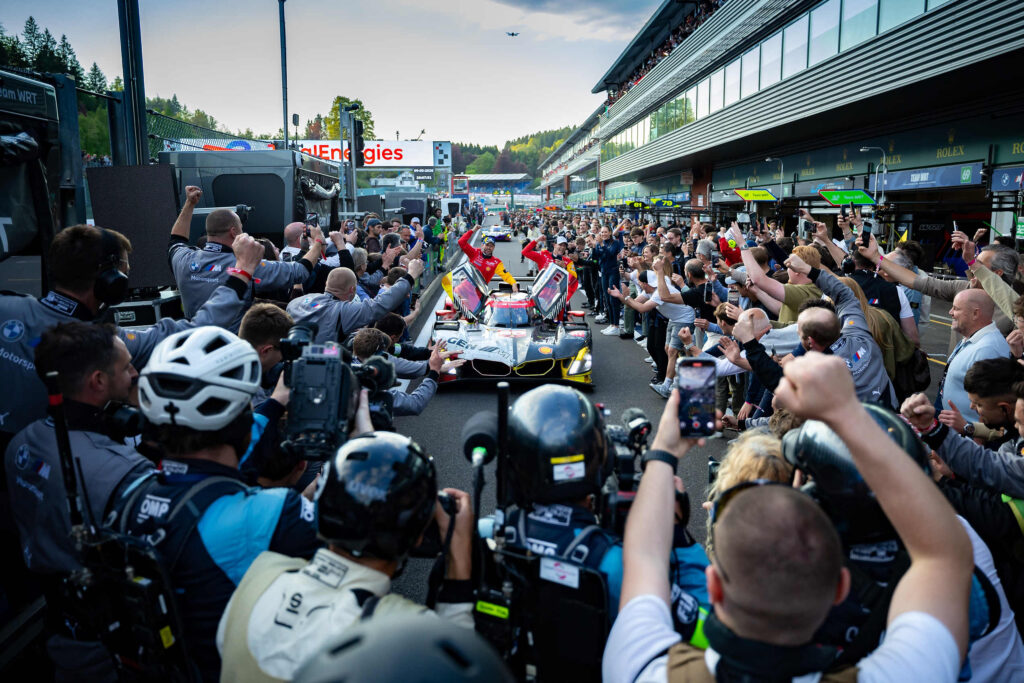
Overall victory went to the #20 BMW M Team WRT crew of Robin Frijns, René Rast and Sheldon van der Linde. Second place went to the #15 BMW of Kevin Magnussen, Raffaele Marciello and Dries Vanthoor, while the #50 Ferrari AF Corse of Antonio Fuoco, Miguel Molina and Nicklas Nielsen finished third. The top five was completed by the #007 Aston Martin THOR Team and the #7 Toyota. The top ten Hypercars completed 151 laps, and the gap between the top three was less than three seconds.
For BMW, the main result was not only the victory itself, but proof of the programme’s maturity. Before Spa, the BMW M Hybrid V8 had often been close to success, but had not managed to combine pace, strategy and clean execution. In Belgium, all three elements came together. After the race, René Rast noted that the team had waited for this moment for more than two years, and that the strategy had effectively created the decisive advantage: BMW took the car out of traffic, gave it clear track, and allowed it to run in its own rhythm.
For Ferrari, the result was mixed. The #50 rescued a podium after a difficult race and a problematic pit stop, but the #51 retired with damage. For Toyota, fifth place for the #7 and tenth for the #8 amounted to damage limitation after a weak qualifying: the team scored points, but did not look in control. Aston Martin, by contrast, achieved an important morale-boosting result: the #007 finished fourth, the best WEC result so far for the Valkyrie, although the retirement of the #009 left a feeling of missed opportunity.
Genesis Magma Racing also deserves attention. The #17 finished eighth and scored points in only the second race for the GMR-001. At such an early stage of the project, that looked like a serious step forward: not a winning result, but an important confirmation of the programme’s potential.
Hypercar top 10
BMW M Team WRT #20 — Frijns / Rast / van der Linde
BMW M Team WRT #15 — Magnussen / Marciello / Vanthoor
Ferrari AF Corse #50 — Fuoco / Molina / Nielsen
Aston Martin THOR Team #007 — Tincknell / Gamble
Toyota Gazoo Racing #7 — Conway / Kobayashi / de Vries
AF Corse Ferrari #83 — Ye / Kubica / Hanson
Peugeot TotalEnergies #93 — Di Resta / Vandoorne / Cassidy
Genesis Magma Racing #17 — Lotterer / Derani / Jaubert
Cadillac Hertz Team JOTA #12 — Deletraz / Stevens / Nato
Toyota Gazoo Racing #8 — Buemi / Hartley / Hirakawa
LMGT3: Garage 59 responds with victory at Spa
The LMGT3 race was no less tense. At first, it looked as though the #21 Vista AF Corse Ferrari could take victory: Simon Mann led for a long period in the middle phase of the race, while Alessio Rovera was expected to finish the job in the final stint. But the key factors became Tom Fleming’s pace in the #10 Garage 59 McLaren in the middle of the race and penalties for rivals.
Victory in LMGT3 went to the #10 Garage 59 McLaren of Antares Au, Tom Fleming and Marvin Kirchhöfer. On the road, the #21 Vista AF Corse Ferrari crossed the line first, but it received a five-second penalty for a final pit-stop infringement and dropped to fourth. The #27 Heart of Racing Team Aston Martin finished second, with the #92 The Bend Manthey Porsche third.
For Garage 59, this victory carried special emotional weight. At Imola, the team had been close to success but lost victory in the closing stages. At Spa, McLaren not only returned to the fight, but won through pace, a strong recovery from its starting position and clean execution in the finale. The #10 Garage 59 started only 15th, but still climbed to the top step of the podium.
LMGT3 top 10
Garage 59 McLaren #10 — Au / Fleming / Kirchhöfer
Heart of Racing Team Aston Martin #27 — James / Robichon / Drudi
The Bend Manthey Porsche #92 — Shahin / Pera / Lietz
Vista AF Corse Ferrari #21 — Heriau / Mann / Rovera
Garage 59 McLaren #58 — West / Gehrsitz / Goethe
Akkodis ASP Team Lexus #87 — Umbrarescu / Schmid / Lopez
Manthey DK Engineering Porsche #91 — Cottingham / Boguslavskiy / Güven
TF Sport Corvette #33 — McDonald / Edgar / Catsburg
Racing Team Turkey by TF Corvette #34 — Dempsey / Yoluc / Eastwood
Iron Lynx Mercedes #61 — Berry / Andrade / Martin
Conclusion: Spa became a race of strategy, mistakes and new intrigue before Le Mans
The 2026 6 Hours of Spa-Francorchamps became one of the key rounds of the first part of the WEC season. Peugeot won qualifying and showed that the 9X8 can be fast over one lap. Cadillac confirmed its pace, but lost the race through a penalty, tyre choice and fading speed in the final phase. Ferrari rescued a podium with one car but lost the other. Toyota scored points, but did not look like the dominant force. Aston Martin achieved the best result yet for the Valkyrie, although its second car retired late on. And BMW turned starts from 10th and 11th into a historic one-two.
The main value of this race was that it broke any simple hierarchy. Before Le Mans, the WEC does not have one obvious favourite, but several lines of tension. BMW goes to France with a victory and strong momentum, Ferrari retains speed and experience, Toyota remains dangerous over a long distance, Cadillac and Alpine have pace, Peugeot has a qualifying breakthrough, Aston Martin has growing confidence, and Genesis has already begun scoring points. Spa showed that in 2026, the Hypercar class is not only large — it is genuinely unpredictable.

