

Mugello is no longer just Ducati territory
The 2026 Italian MotoGP Grand Prix became one of the key races of the first half of the season. At a circuit where Ducati has traditionally been strong, Aprilia did more than simply challenge — it took the win, sealed a one-two finish and showed that the balance of power in the championship had shifted.
Mugello is a special place for MotoGP. Its long main straight, fast direction changes, elevation changes, heavy braking zones and huge emotional pressure make the Italian round one of the toughest weekends on the calendar. It is a circuit where weaknesses are quickly exposed: if a bike lacks braking stability, drive out of corners or tyre management, it shows over race distance.
That is why Marco Bezzecchi’s victory on the Aprilia was more than just a memorable home win. It confirmed that Aprilia is no longer playing the role of the chasing manufacturer in 2026. It is now capable of setting the pace itself.
Friday: Di Giannantonio sets the pace as Aprilia stays close
Friday at Mugello did not begin with outright Aprilia dominance, but with a strong showing from the Italian group. Fabio Di Giannantonio was the standout rider of the opening day, topping the Friday sessions on the VR46 Ducati, while Francesco Bagnaia, Enea Bastianini and Franco Morbidelli also featured near the sharp end. For the home crowd, it was a familiar and welcome sign: the Italian riders and Ducati were still quick at Mugello.
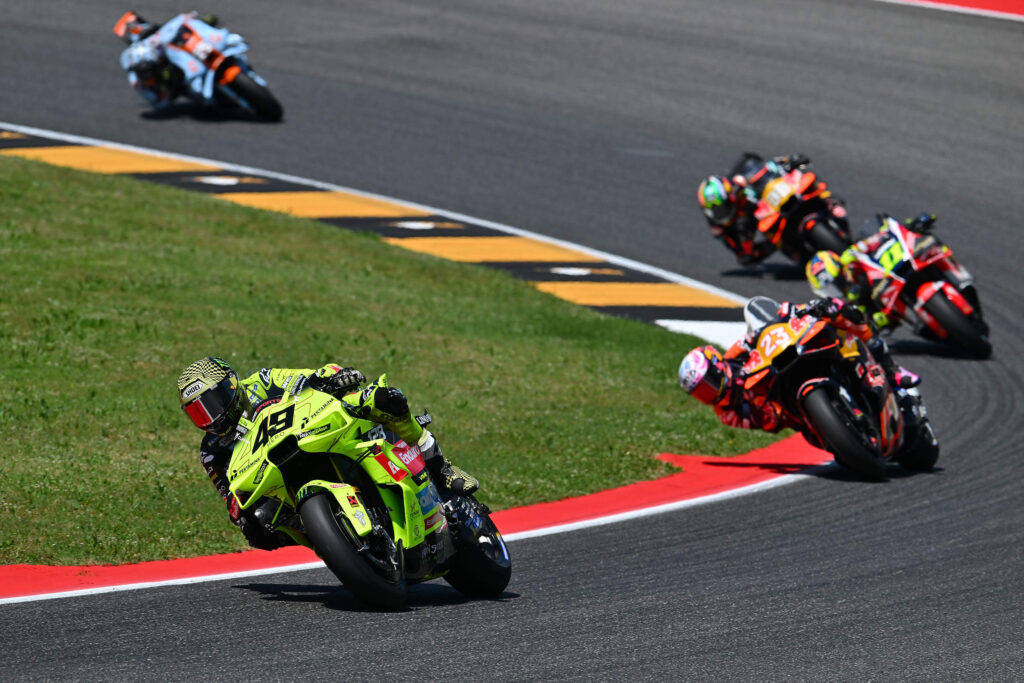
www.photopsp.com
But behind that Italian start, another storyline was already taking shape. Aprilia did not look dominant on Friday, yet Marco Bezzecchi and Jorge Martin remained comfortably within the working range on pace. It was not an explosive start, but rather a controlled build-up towards Saturday, when the potential of the RS-GP would become far more visible.
At Mugello, that matters. A single fast lap is not enough here. The circuit demands a bike that can stay stable on the brakes, change direction cleanly and avoid destroying its tyres by mid-distance. Aprilia did not look like a machine in full control of the weekend from the first sessions, but it was already showing that it had the base to fight.
Ducati was very much in the game, and on Friday its presence was especially clear. Bagnaia, Di Giannantonio and the other Ducati riders confirmed their pace at the home track, but the usual sense of absolute superiority was missing. Aprilia was close enough to be seen not as an outside threat, but as a real contender for Saturday and Sunday.
By Friday evening, the main conclusion was not that Aprilia was already dominating. It was that the weekend remained wide open. Ducati and VR46 had started strongly, but Aprilia was quietly preparing its response.
Saturday: pole, sprint victory and a speed record
Saturday was the day the weekend swung sharply towards Aprilia. If Friday had been about Ducati and VR46’s strong Italian pace, qualifying put Aprilia firmly into the spotlight. Marco Bezzecchi took pole position, and Aprilia locked out the front row, turning Saturday into a serious warning for its rivals.
For Bezzecchi, pole at Mugello carried special meaning. A home circuit, Italian grandstands, an Italian bike and the chance to start the main race from a position of strength all created a powerful storyline. But the bigger point was that Aprilia showed its speed was not limited to race pace. The bike was fast over one lap as well.
Saturday also produced a new top-speed record. Jorge Martin reached 368.6 km/h, setting a new all-time MotoGP speed record. At Mugello, that number carries extra weight. The Italian circuit has always been a place where top speed becomes part of the show, but almost 370 km/h was a separate symbol of modern MotoGP.
The record was not only about engine power. It confirmed the efficiency of the whole racing package: aerodynamics, the bike’s attitude on the straight, stability at extreme speed and the ability to remain controlled after the highest-speed section of the lap.
The main event of Saturday was the sprint. Raul Fernandez won the short race on the Trackhouse Aprilia, again proving that Aprilia’s strength at Mugello was not limited to the factory team. The satellite bike was competitive enough to fight for victory and take important weekend points in a tight battle.
For Ducati, it was an uncomfortable warning. On its home ground, Aprilia was fast not only with its factory riders, but also with its satellite team. That meant the problem for its rivals was bigger than one strong lap from Bezzecchi or a good run from Martin. The whole package was working.
Sunday: Bagnaia leads early, but Bezzecchi takes the race
Sunday’s race initially followed a familiar Mugello script. Francesco Bagnaia made a strong start, moved to the front and looked in the opening laps as if Ducati might still bring its home race back under control.
For the Italian fans, it was almost the perfect start. The factory Ducati was leading, Bagnaia was out front, the grandstands were watching a familiar picture unfold, and Aprilia had to chase. But this race quickly showed that the familiar script no longer guarantees the familiar result.
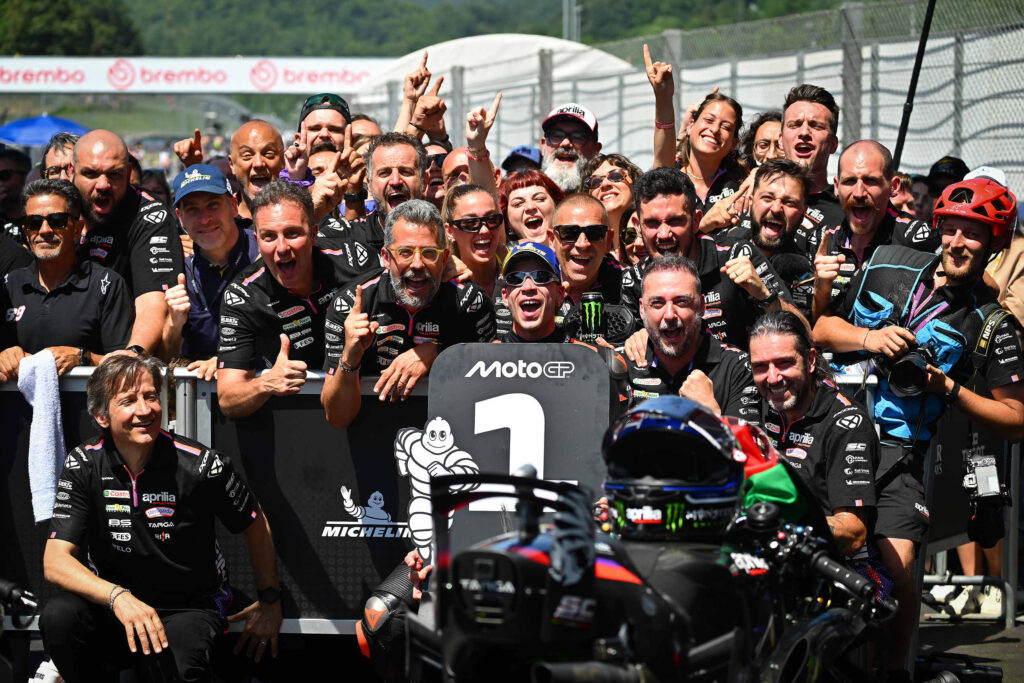
Marco Bezzecchi did not let the leader get away. He stayed close, avoided overheating the tyres with early attacks and did not try to win the race with one risky move. His ride looked very mature: pace control, pressure on the leader and patience until Aprilia could use its advantage over the distance.
The decisive phase came in the second half of the race. Bezzecchi passed Bagnaia with ten laps to go and quickly made it clear that this was not a one-off attack, but the turning point of the whole grand prix. From there, he began to pull away, and Aprilia effectively took control of the race.
Martin completes Aprilia’s one-two
Jorge Martin’s second place was just as important for Aprilia’s overall result. If Bezzecchi’s win gave the race its emotional centre, Martin’s finish confirmed the strength of the RS-GP over full race distance.
Martin rode without unnecessary risk, but with high and consistent pace. He also passed Bagnaia and secured Aprilia’s one-two at the Italian Grand Prix. For the manufacturer, the symbolism was huge: two Aprilias at the front, Ducati only third, and all of it happening at Mugello.
Crucially, Aprilia’s success did not look dependent on one rider or one perfect set-up. The bike was strong across the weekend: on Friday it stayed close to the leaders, on Saturday it came alive in qualifying and the sprint, and on Sunday it confirmed its pace over the full distance.
Ducati saves a podium but loses the pace battle
Bagnaia’s third place allowed Ducati to remain on the podium at its home round. But the race itself showed that this was more of a defensive result than a genuine fight for victory.
Bagnaia led early, but could not match Aprilia’s pace over the distance. After Bezzecchi passed him, he lost control of the race, then also had to give way to Martin. In the closing stages the situation became even more tense, with Ai Ogura on the Trackhouse Aprilia closing in and almost joining the fight for third.
For Ducati, that was a warning sign. If a factory Ducati rider has to defend a Mugello podium from a satellite Aprilia, the advantage that once felt almost automatic is no longer there.
Ogura confirms Trackhouse Aprilia’s strength
Ai Ogura was one of the standout stories of Sunday’s race. Fourth place on the Trackhouse Aprilia was not just a strong personal result. It was further proof that Aprilia’s competitive package extends beyond the factory team.
Ogura had the pace to stay in the podium fight and was a real threat to Bagnaia in the closing stages. In modern MotoGP, that matters. If a customer bike can attack a factory Ducati at Ducati’s home circuit, it is no longer just about one rider having a good day.
Trackhouse Aprilia’s speed added weight to the whole weekend. Bezzecchi’s win, Martin’s second place, Fernandez’s sprint victory and Ogura’s near-podium all pointed in the same direction: Aprilia was strong across the board.
Marquez remains outside the victory fight
Against Aprilia’s success, Marc Marquez’s race was more restrained. He remained involved in the pack, attacked, defended and stayed visible in the fight, but he did not have the pace to challenge for the podium.
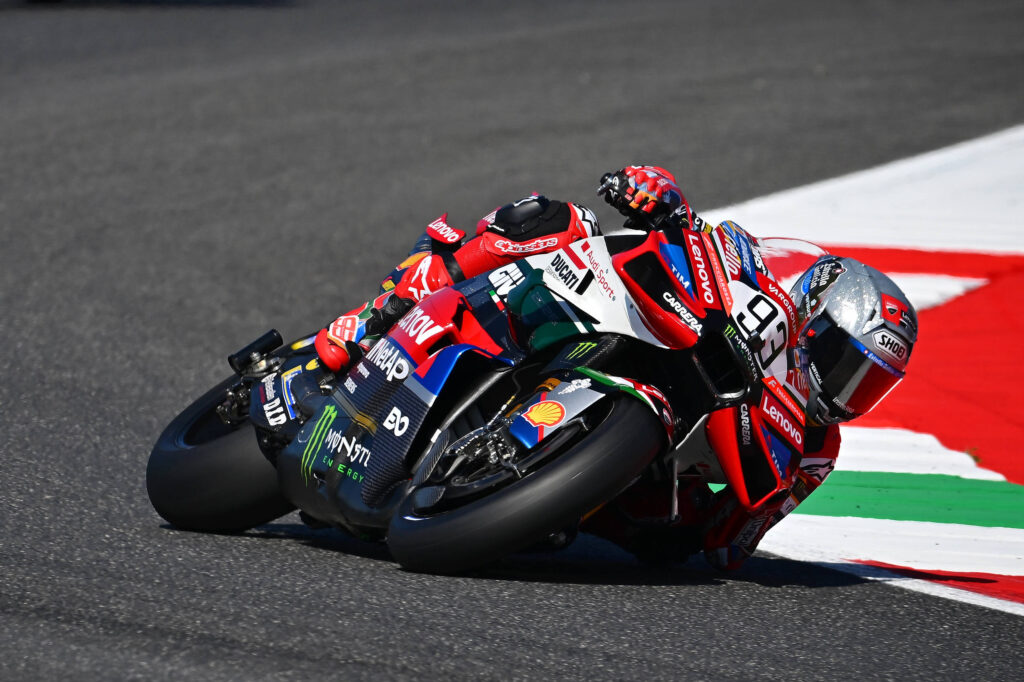
Seventh place was not a disaster, but in the championship context it is not enough to relax. If Bezzecchi, Martin and Aprilia continue to take big points regularly, Marquez and Ducati will need to find an answer quickly.
Marquez remains a rider capable of changing a race with a single move. But Mugello showed that talent and aggression are not enough when the race pace and stability over distance are missing.
Acosta and Di Giannantonio in the chasing group
Pedro Acosta and Fabio Di Giannantonio both had strong weekends, but remained in the chasing group. Di Giannantonio was especially impressive on Friday and confirmed that VR46 can fight near the top of the timesheets, even if the main Sunday pace belonged to Aprilia.
Acosta again showed that he can race in the leading group. He was aggressive on the brakes, stayed close to his rivals and rode with his usual attacking style. But KTM lacked the overall pace at Mugello to join the victory fight.
The midfield and chasing group at Mugello once again showed how tight MotoGP has become. The difference between fighting for a podium and finishing sixth or seventh can come down to small details: front tyre temperature, braking stability, drive out of fast corners or how the bike behaves in the slipstream.
Why this win matters for the championship
The main takeaway from the Italian Grand Prix is clear: Aprilia can no longer be seen as a team waiting for Ducati to make mistakes. At Mugello, it created the pressure, won the key sessions and controlled the race pace.
For Bezzecchi, the victory was a personal triumph. Winning at Mugello is already special for an Italian rider. Doing it on an Aprilia, against Ducati and in front of the home crowd gives the result a much deeper meaning.
For Aprilia, it was a landmark weekend. The team won the grand prix, took a one-two finish, added a sprint victory through Trackhouse and came close to another podium with Ogura. That combination of results points not to a one-off peak, but to a mature project.
Ducati receives a warning for the rest of the season
For Ducati, Mugello 2026 was a painful weekend. Yes, Bagnaia made the podium, but the team could not impose its race on Aprilia. At home, Ducati lost not only the win, but also the initiative.
That does not mean Ducati is out of the fight. It still has speed, experience, strong riders and huge technical depth. But the old feeling that Ducati controls the championship by default is gone.
Now it needs to respond not only through individual results, but through development of the overall package. Aprilia has already shown that it can win where Ducati was once expected to lead.
Conclusion: Mugello changed the question
The 2026 Italian Grand Prix changed the central question of the season. Before Mugello, the storyline was often about who could get close enough to challenge Ducati.
After Mugello, the question is different: who can stop Aprilia if it keeps performing at this level?
Mugello has always been a circuit of speed, noise and Italian passion. In 2026, it also became the place where Aprilia loudly announced itself as a genuine championship contender.

