

Interlagos rarely allows a race to unfold in a straight line. Even when it is not Formula 1, but a six-hour endurance race, this circuit almost always demands more than outright speed. It asks for rhythm, traffic management, braking stability, traction out of the slower corners, clean pit work and the ability to stay composed when the sun, rain, tyres and rivals begin to shift the balance of the race.
The 2026 6 Hours of São Paulo was exactly that kind of contest.
Cadillac arrived in Brazil as the star of qualifying. The two Hertz Team JOTA cars locked out the front row, Will Stevens took his first WEC pole in ten years, and the American marque again looked especially strong at Interlagos. But on Sunday, it was not Cadillac that won the race.
Victory went to BMW M Team WRT.
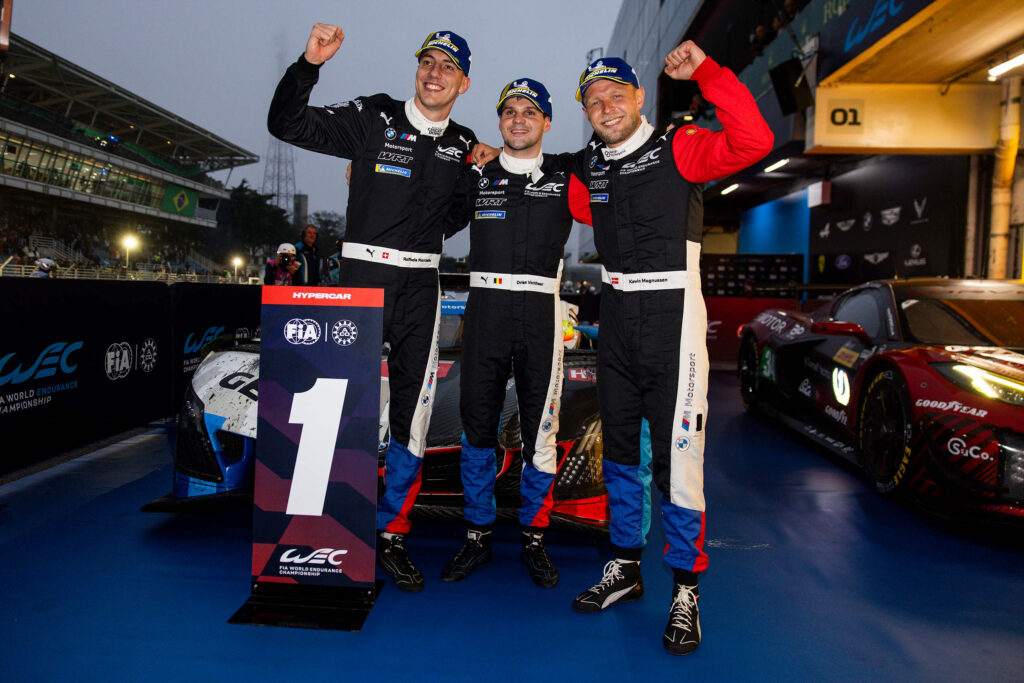
The No. 15 BMW crew of Kevin Magnussen, Raffaele Marciello and Dries Vanthoor started from fourth, quickly inserted itself into the fight with Cadillac, capitalised on its rivals’ problems in the pits, withstood pressure from Ferrari and delivered BMW’s second victory of the 2026 FIA World Endurance Championship season. At the finish, the top three were covered by less than seven seconds: the No. 15 BMW, the No. 51 Ferrari and the No. 12 Cadillac. For a six-hour race, that was almost sprint-race density.
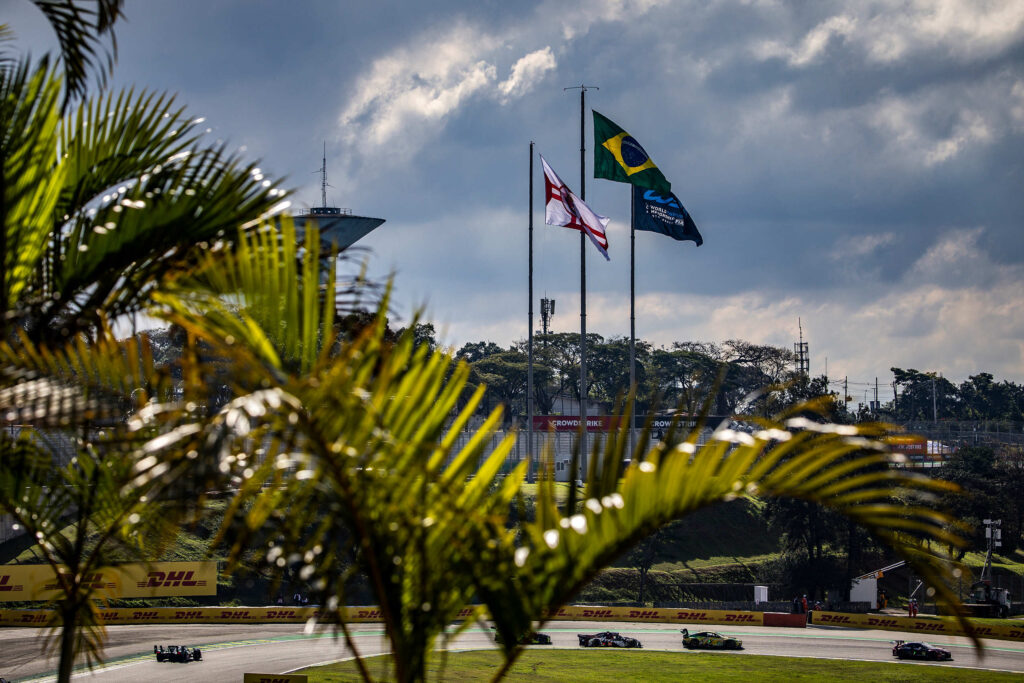
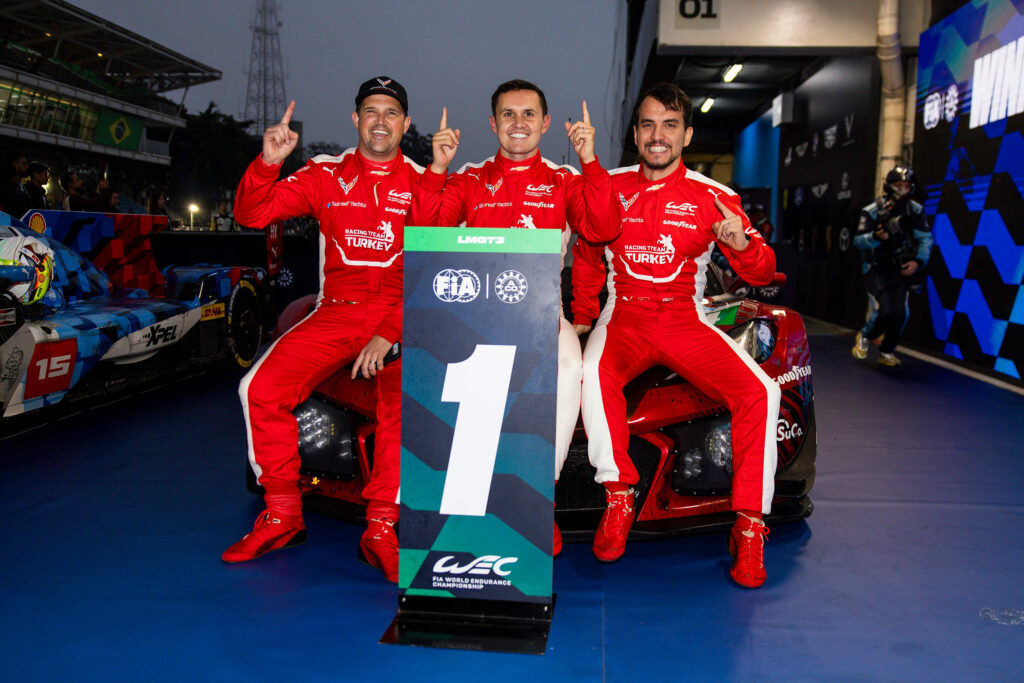
In LMGT3, victory went to Racing Team Turkey by TF with its Corvette Z06 GT3.R. Salih Yoluç, Peter Dempsey and Charlie Eastwood won the class after surviving a late scare with a slow puncture. For TF Sport, it was a second consecutive LMGT3 victory with Corvette after Le Mans, but this time with a different car.
This was a race in which qualifying promised a Cadillac day, strategy briefly put Alpine into control, Ferrari almost rescued victory after a difficult Saturday, and BMW ultimately proved to be the most complete team on Sunday.
Interlagos: 4.309 kilometres, 15 corners and almost 85,000 fans
The Brazilian round of the 2026 FIA WEC took place from 10 to 12 July at the Autódromo José Carlos Pace. The WEC layout of Interlagos measured 4.309 kilometres and featured 15 corners — eight left-handers and seven right-handers. The race started on Sunday at 11:30 local time.
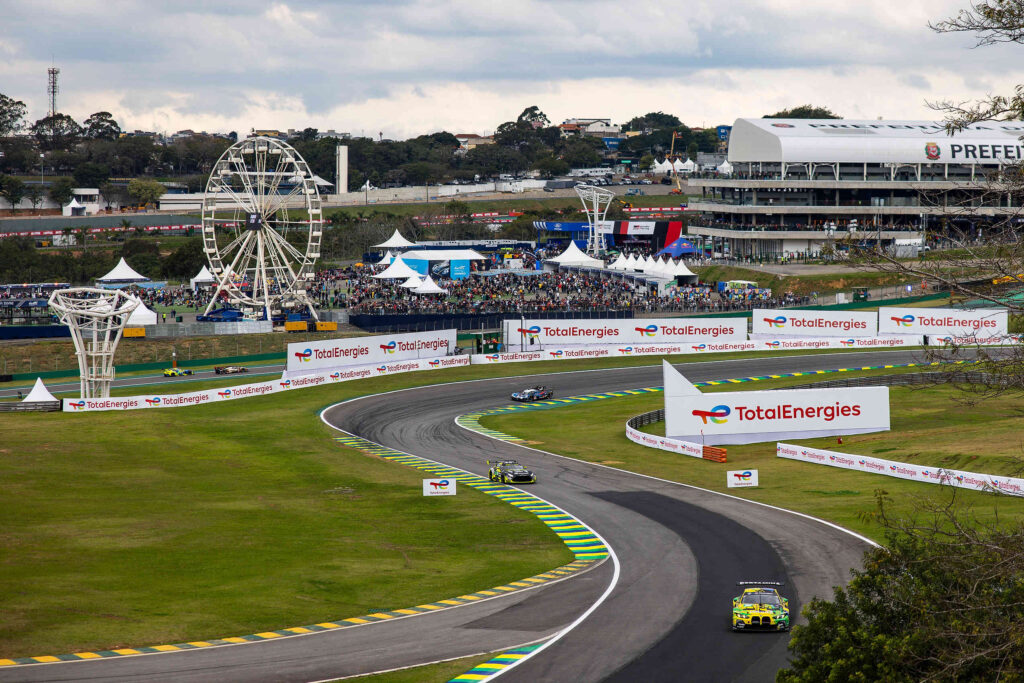
For the championship, São Paulo was the first round after Le Mans and therefore carried particular importance. It had to show who could really build momentum in the second half of the season, and who was still living in the emotional shadow of the 24 Hours of Le Mans.
The grandstands were close to full, with the official WEC report putting the weekend attendance at almost 85,000 spectators. For an endurance race, that matters. Interlagos once again felt not merely like a calendar stop, but like a major international motorsport event in its own right.
The race itself was relatively clean in terms of major interruptions. There was only a brief Full Course Yellow in the second hour to clear debris from the circuit, and all 35 cars that started reached the finish. Light rain arrived late in the race, but it never turned the closing stages into chaos.
Qualifying: Cadillac locks out the front row
Saturday belonged to Cadillac.
Will Stevens took pole in the No. 12 Cadillac with a 1:23.041. The sister No. 38 Cadillac of Jack Aitken, Earl Bamber and Sébastien Bourdais was just 0.048 seconds slower, while the No. 36 Alpine was third, only 0.067 seconds off pole. It was an extremely tight Hyperpole session, but once again Cadillac was the manufacturer that extracted the most from one lap at Interlagos.
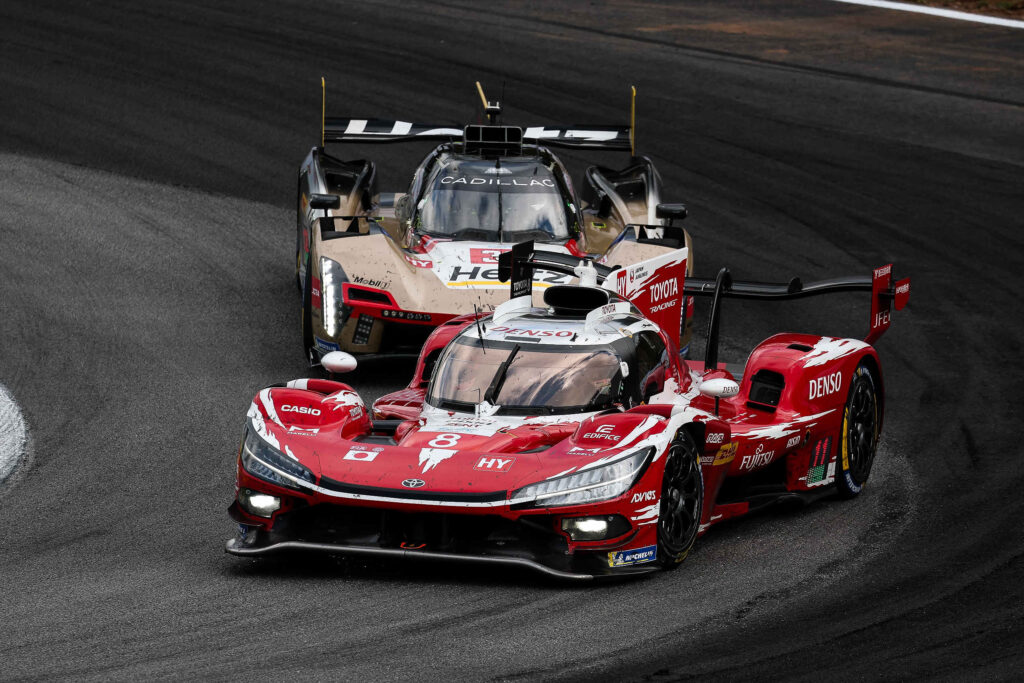
For Stevens, it was a special moment: his first FIA WEC pole position in ten years. For Cadillac, it was another strong qualifying performance in Brazil. This circuit had already been the scene of a major result for the programme the previous year, and after Saturday in 2026, it looked as though the story might repeat itself.
The No. 15 BMW started only fourth. But even then, it was clear that if the car had race pace, it did not need pole to fight for victory.
In LMGT3, the No. 23 Heart of Racing Team Aston Martin took pole after an excellent Hyperpole lap from Kobe Pauwels. But Bronze-rated driver Gray Newell started the race, and a difficult opening phase quickly put the car under pressure from the rest of the class.
Start: Stevens leads, Magnussen immediately disrupts Cadillac’s plan
The race began on a slightly damp track. Even before the start, Mike Conway made a mistake on the reconnaissance lap in the No. 7 Toyota, touched the pit-lane wall and forced the team to replace the front bodywork. For the recent Le Mans winners, it was a bad sign before the race had even officially begun.
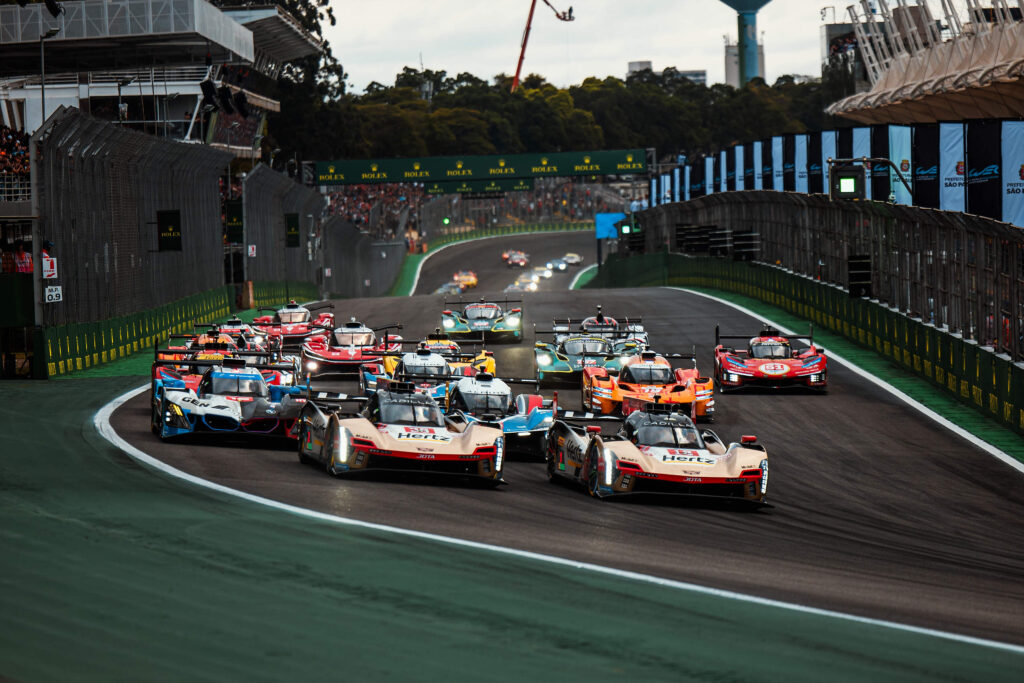
At the start, Will Stevens held the lead comfortably in the No. 12 Cadillac and began to build a gap. But behind him, Kevin Magnussen immediately changed the shape of the race. The Dane in the No. 15 BMW passed the No. 36 Alpine into Turn 1, then dealt with Earl Bamber’s No. 38 Cadillac and, still in the first hour, had already driven between the two V-Series.Rs that had started from the front row.
That was the first key moment of the race.
Cadillac still held first place, but it had already lost control of the front row. BMW had split the two V-Series.Rs and was beginning to apply pressure to Stevens. Magnussen initially reported a lack of power, but the pace soon came back, and the BMW became a genuine threat to the leader.
From that point on, the race was no longer simply about whether Cadillac could convert pole into victory. It became a question of who would make the first costly mistake in a fight involving Cadillac, BMW, Ferrari and Alpine’s strategic gamble.
Alpine plays the strategy and briefly takes control
The No. 35 Alpine of Ferdinand Habsburg, Charles Milesi and António Félix da Costa became one of the most interesting cars in the first half of the race. The team committed to shorter stints, prioritised track position and, in the second hour, moved into the lead.
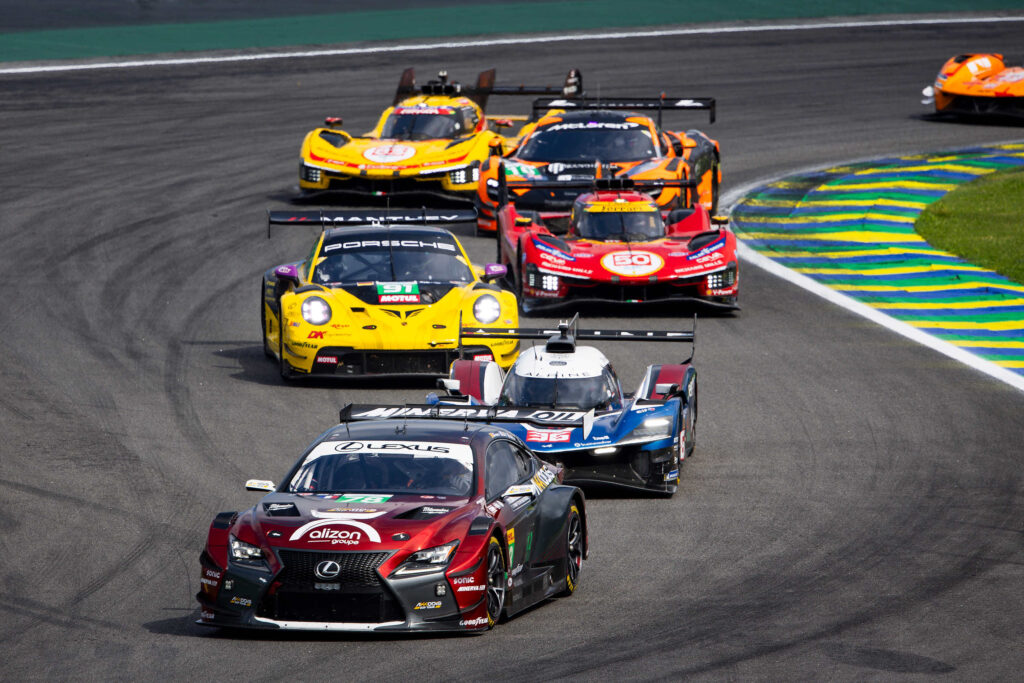
It was a bold call. At Interlagos, where LMGT3 traffic, track temperature and the short lap quickly mix the classes together, clean air and track position can sometimes be worth almost as much as the perfect theoretical strategy. Alpine did not take the lead because it was unquestionably the fastest car of the day. It took the lead because it tried to win the race in a different way.
In the middle phase, the plan looked convincing. António Félix da Costa held the lead for a significant part of the third and fourth hours, while Alpine remained on a strategy that differed from most of its rivals. This was not a brief cameo early in the race. Alpine genuinely became part of the battle for control of the middle distance.
But that kind of strategy always needs a second act. As the pit cycles began to converge and the opposition returned to more conventional stint and tyre calculations, Alpine’s advantage started to fade. In the end, the gamble did not deliver a major result: the No. 35 crew finished tenth and scored only a single point.
Even so, Alpine was an important part of the race. It forced the leaders to react and showed just how narrow the strategic margins were in Brazil.
The pit stops that changed Cadillac’s race
The decisive blow to the No. 12 Cadillac came during the first round of pit stops.
Stevens’ car lost roughly 15 to 20 seconds because of a stuck front-right wheel nut. In a six-hour race, that is not necessarily fatal, but in such a tightly packed Hypercar field it immediately costs positions. Cadillac dropped back and had to fight its way through traffic and rivals.
Stevens put together a strong recovery stint. He passed the No. 8 Toyota, the No. 51 Ferrari and the No. 83 Ferrari as he pulled the Cadillac back into contention. The problem was that BMW had already been given a cleaner route towards the front.
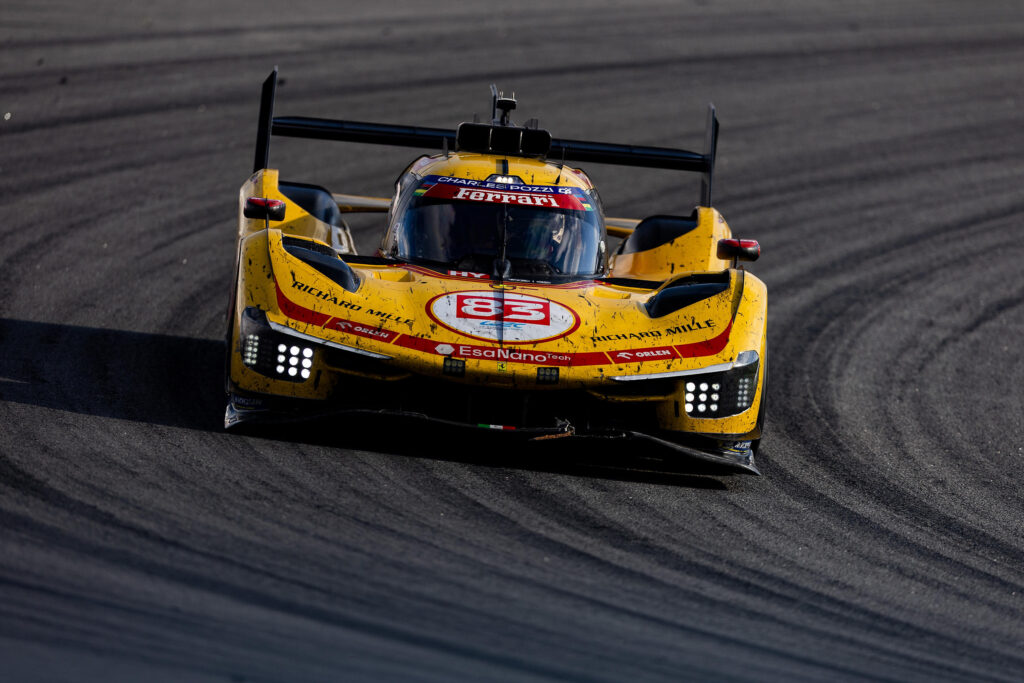
The second Cadillac, the No. 38, also lost time at its first stop because of an issue on pit entry. It later received a five-second penalty for contact, applied after the finish. In effect, the team that had locked out the front row lost control of the race just as BMW began to put together its perfect Sunday.
Both Cadillacs still finished third and fourth. That was a strong result, particularly after the time lost, but after starting from the front row and showing such clear speed in qualifying, it was difficult to imagine the team being fully satisfied.
BMW takes control
After Cadillac’s pit issues, the race gradually came towards the No. 15 BMW.
Magnussen did the crucial work early on, putting the car in the right position. Marciello maintained the pace through the middle phase. Vanthoor, despite feeling unwell, delivered composed final stints and held off the pressure from Ferrari and Cadillac.
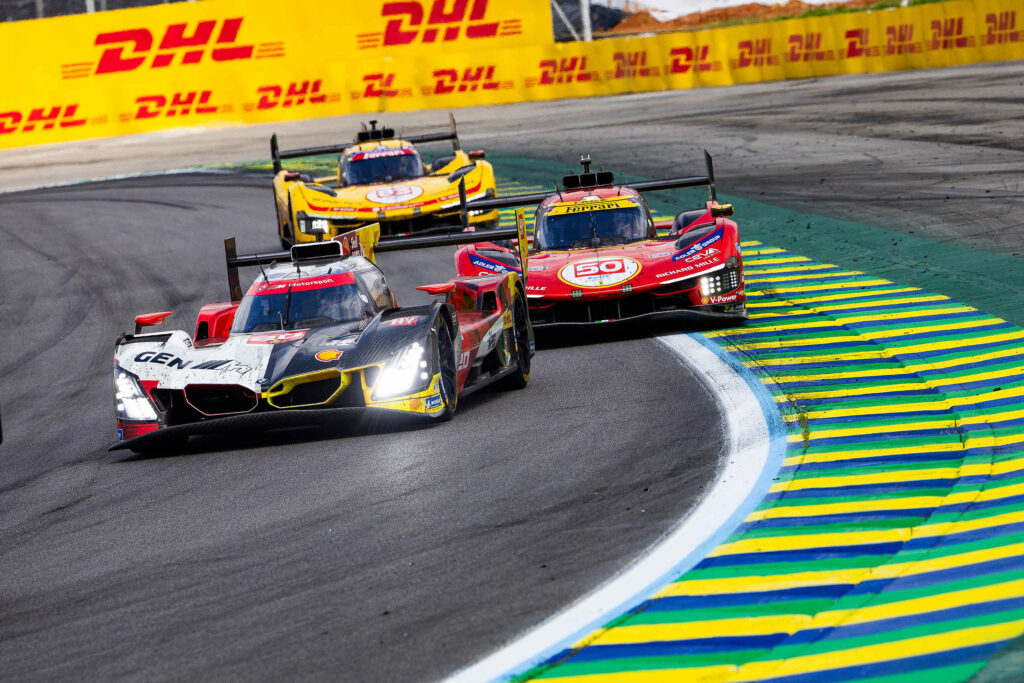
This was not a fortunate BMW victory. The team had already won earlier in the 2026 season, but the São Paulo success for the No. 15 car mattered in a different way. It showed that BMW could win not only through strategic circumstances, but in a direct fight against Ferrari and Cadillac.
In the closing laps, Vanthoor came under threat from the No. 51 Ferrari and the recovering No. 12 Cadillac. But BMW’s advantage was just enough: the winning margin over Ferrari was only 2.254 seconds, with the Cadillac 6.687 seconds behind the winner.
For a six-hour race, that was almost a photo finish.
For Magnussen, Marciello and Vanthoor, it was also a personal milestone: all three took their first overall victory in the FIA WEC. For Magnussen, who once claimed a Formula 1 pole position at Interlagos, winning in Brazil with BMW added another neat line to his career.
Ferrari No. 51 rescues the Scuderia’s day
Ferrari had a strange weekend.
In qualifying, the factory cars did not look like the main favourites. But in the race, the No. 51 Ferrari of Alessandro Pier Guidi, James Calado and Antonio Giovinazzi gradually worked its way forward. WEC described the recovery as a stealthy climb through the order, and that was a fair description: Ferrari did not seize the race by force, but it stayed close enough to take advantage of every opportunity.
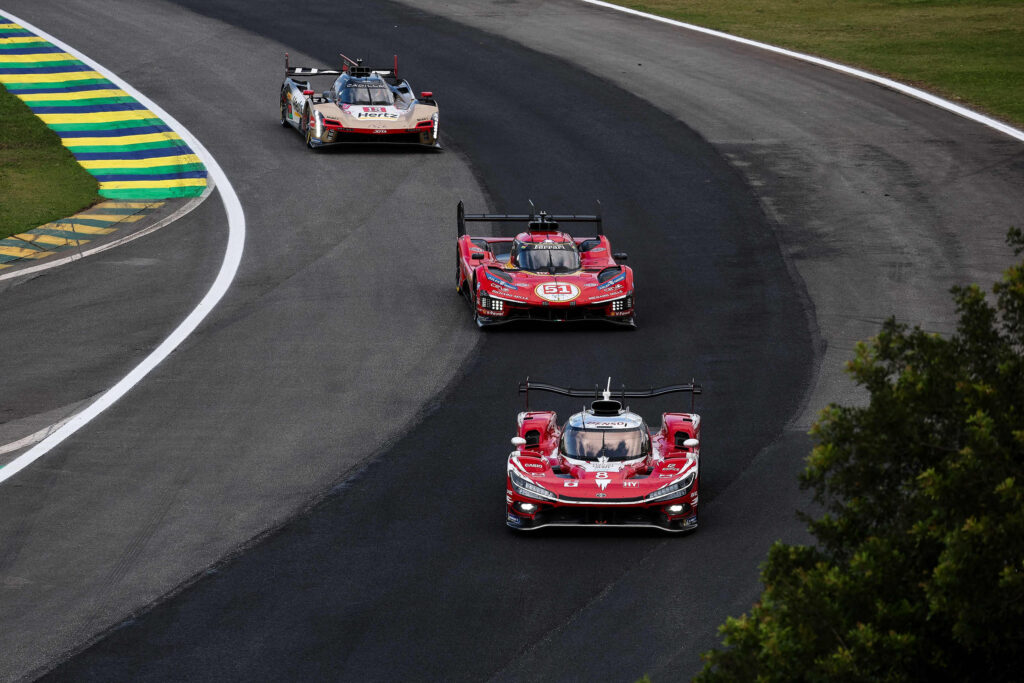
Giovinazzi had an eventful opening phase, and the car was involved in several contacts and investigations, but the crew never dropped out of the competitive window. By the end, the No. 51 Ferrari had become BMW’s main challenger. Calado brought the car home in second place, matching the crew’s best result of the season.
For the world champions, it was an important result. Ferrari did not win, but after a difficult qualifying session and a hard fight with Cadillac, it avoided a major setback and kept itself in the group of contenders.
The No. 83 AF Corse Ferrari finished fifth, while the factory No. 50 car took seventh after a late incident with the No. 20 BMW, which left the Frijns/Rast/Sheldon van der Linde crew penalised and dropped to eighth.
Toyota: a difficult day after Le Mans
For Toyota, São Paulo was almost the opposite of Le Mans.
After its major victory in France, the team arrived in Brazil leading the manufacturers’ championship, but at Interlagos both cars were a long way from podium contention. The official WEC report made clear how difficult the weekend was for Toyota, with the Japanese cars lacking speed throughout the race.
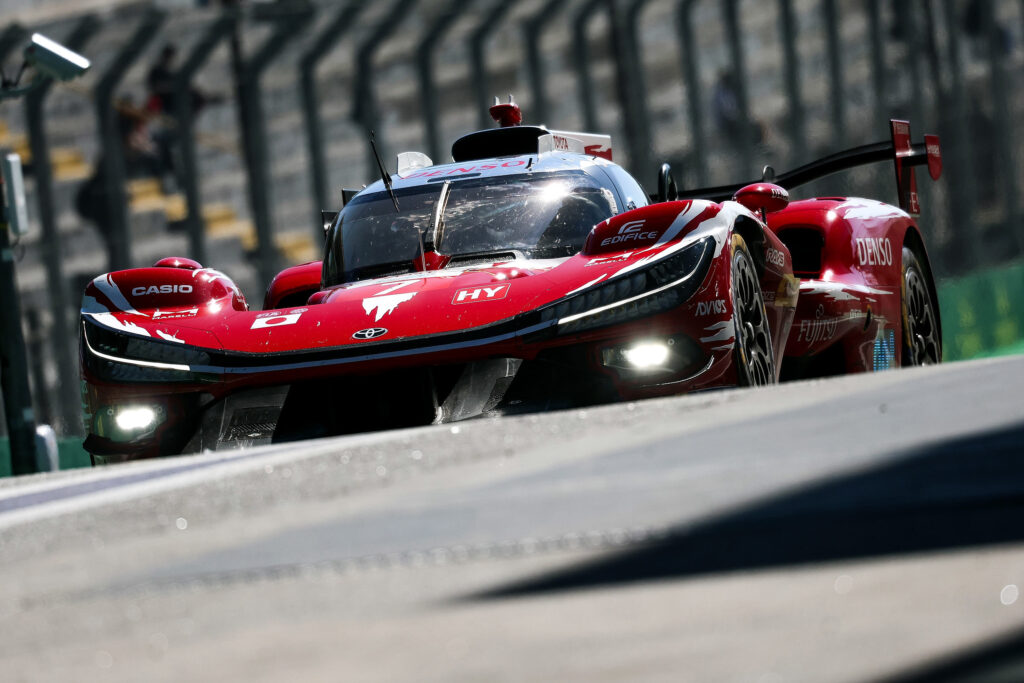
The No. 7 Toyota, the Le Mans-winning car, finished only 12th and one lap behind the leader. The No. 8 had an even tougher race: after a series of contact incidents, including clashes with Aston Martin and Genesis machinery, it lost more than ten laps in the pits and eventually finished 17th, 12 laps down.
The paradox of the WEC season, however, is that even a day like this did not destroy Toyota’s position completely. The Japanese manufacturer retained the lead in the manufacturers’ championship, although BMW’s victory brought the gap down to almost nothing.
Aston Martin, Genesis and Peugeot: useful days, difficult days
Aston Martin produced one of its most complete rounds of the season. The No. 007 Valkyrie finished sixth, while the No. 009 car came home ninth. In the manufacturers’ standings after São Paulo, Aston Martin was just one point behind Alpine — 40 to 41. For a Hypercar programme still accumulating mileage and experience, Brazil was a useful weekend.
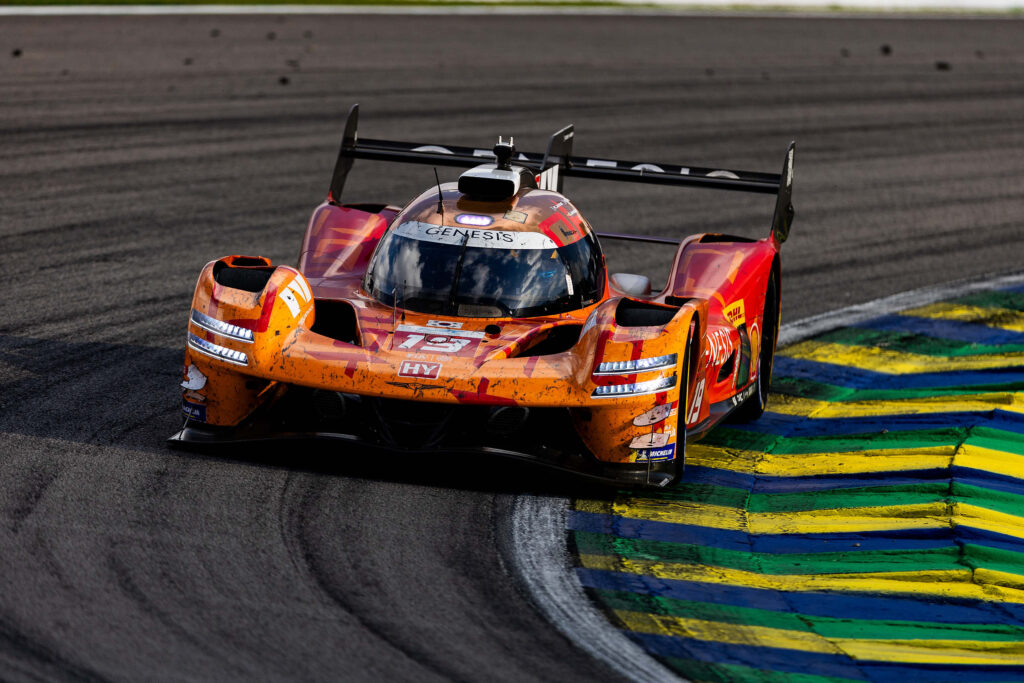
Genesis again showed signs of speed, but the final result remained limited. The No. 19 finished 13th and the No. 17 15th. In the opening hours, Genesis had contacts and traffic incidents, including a clash between one of its cars and the No. 8 Toyota. At this stage, it still feels more like a story of development than results.
Peugeot left without points: the No. 94 finished 14th and the No. 93 16th. After several more visible performances earlier in the season, Brazil was a step backwards for the French squad.
Hypercar results
| Pos. | Car | Team | Laps | Gap |
|---|---|---|---|---|
| 1 | #15 BMW M Hybrid V8 | BMW M Team WRT | 242 | 6:00:26.462 |
| 2 | #51 Ferrari 499P | Ferrari AF Corse | 242 | +2.254 |
| 3 | #12 Cadillac V-Series.R | Cadillac Hertz Team JOTA | 242 | +6.687 |
| 4 | #38 Cadillac V-Series.R | Cadillac Hertz Team JOTA | 242 | +12.666 |
| 5 | #83 Ferrari 499P | AF Corse | 242 | +32.351 |
| 6 | #007 Aston Martin Valkyrie | Aston Martin THOR Team | 242 | +35.566 |
| 7 | #50 Ferrari 499P | Ferrari AF Corse | 242 | +39.952 |
| 8 | #20 BMW M Hybrid V8 | BMW M Team WRT | 242 | +40.047 |
| 9 | #009 Aston Martin Valkyrie | Aston Martin THOR Team | 242 | +45.523 |
| 10 | #35 Alpine A424 | Alpine Endurance Team | 242 | +56.996 |
The final Hypercar classification underlined just how tight the race had been: the top three were covered by 6.687 seconds, and the entire top ten finished within a minute.
LMGT3: Racing Team Turkey by TF wins with Corvette
The LMGT3 race did not follow the pattern suggested by qualifying either.
The No. 23 Heart of Racing Team Aston Martin started from pole after Kobe Pauwels’ Hyperpole lap, but Gray Newell had a difficult opening stint and quickly came under pressure from the pack. In the early minutes, the No. 79 Iron Lynx Mercedes and the No. 87 Akkodis ASP Lexus moved forward. Then the two Proton Competition Ford Mustangs joined the fight: first Stefano Gattuso in the No. 88, then Eric Powell in the No. 77. At one stage, Ford was running first and second, but that picture did not last until the finish.
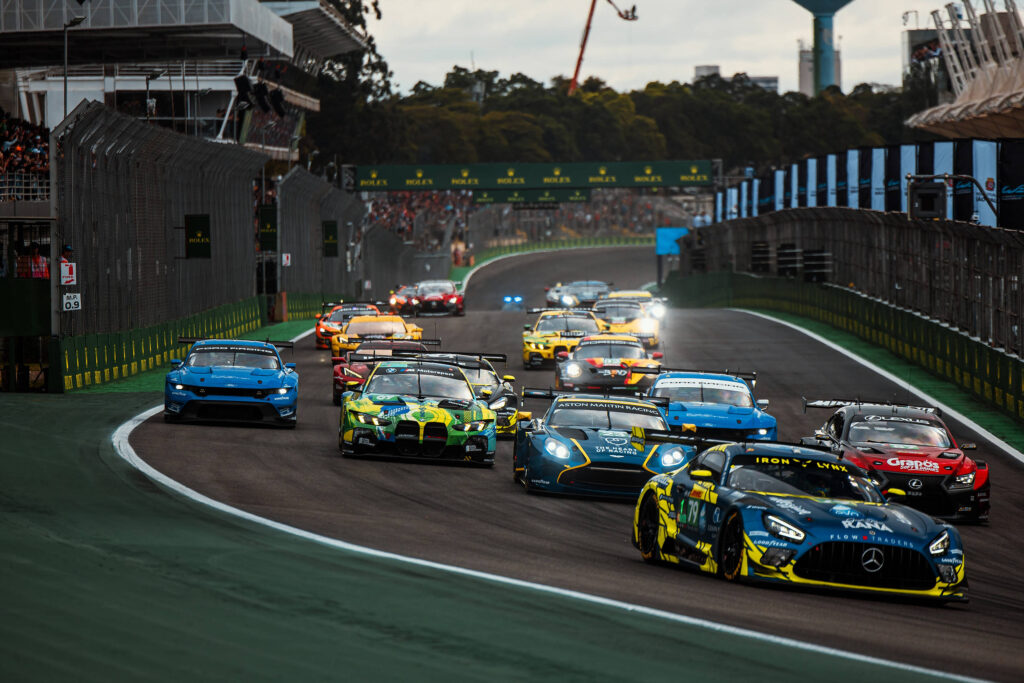
The main story of the class became the No. 34 Racing Team Turkey by TF Corvette.
The team chose an alternative strategy: Silver-rated driver Salih Yoluç started the race before handing over to Bronze-rated Peter Dempsey. The call worked. Yoluç delivered strong stints, Dempsey kept the car in contention, and in the fifth hour Charlie Eastwood took over the Corvette in a strong position.
Eastwood passed the No. 69 Team WRT BMW and the No. 92 The Bend Manthey Porsche, built a gap and carried the car to victory. Even a slow puncture in the closing phase did not derail the race: the Corvette finished 8.108 seconds ahead of the BMW.
For Racing Team Turkey, it was a first WEC victory. For TF Sport, it was a second consecutive LMGT3 win with Corvette after Le Mans.
LMGT3 podium and the fight behind
Second place went to the No. 69 Team WRT BMW of Anthony McIntosh, Parker Thompson and Dan Harper. The result was especially important for the championship, moving the team into the dense chasing group behind the points-leading No. 33 TF Sport Corvette.
Third went to the No. 92 The Bend Manthey Porsche. For Yasser Shahin, Riccardo Pera and Richard Lietz, it was a third podium of the season and a strong response after a difficult Le Mans. In the closing stages, Lietz had to defend from Logan Sargeant in the No. 88 Ford, before Sargeant himself lost fourth place when Ayhancan Güven passed him in the No. 91 Porsche in the final minutes.
The No. 88 Ford finished fifth, the No. 61 Iron Lynx Mercedes sixth and the No. 87 Lexus seventh. The championship-leading No. 33 TF Sport Corvette finished eighth but retained a strong lead in the LMGT3 teams’ standings.
LMGT3 results
| Pos. | Car | Team | Laps | Gap |
| 1 | #34 Corvette Z06 GT3.R | Racing Team Turkey by TF | 219 | 6:00:29.704 |
| 2 | #69 BMW M4 GT3 Evo | Team WRT | 219 | +8.108 |
| 3 | #92 Porsche 911 GT3 R | The Bend Manthey | 218 | +1 lap |
| 4 | #91 Porsche 911 GT3 R | Manthey DK Engineering | 218 | +1 lap |
| 5 | #88 Ford Mustang GT3 | Proton Competition | 218 | +1 lap |
| 6 | #61 Mercedes-AMG GT3 Evo | Iron Lynx | 218 | +1 lap |
| 7 | #87 Lexus RC F GT3 | Akkodis ASP Team | 218 | +1 lap |
| 8 | #33 Corvette Z06 GT3.R | TF Sport | 218 | +1 lap |
| 9 | #21 Ferrari 296 LMGT3 | Vista AF Corse | 218 | +1 lap |
| 10 | #77 Ford Mustang GT3 | Proton Competition | 218 | +1 lap |
The official FIA WEC classification gave victory to the No. 34 Racing Team Turkey by TF Corvette with 219 laps completed and an 8.108-second margin over the No. 69 BMW.
Hypercar championship: BMW brings the fight back to life
After São Paulo, the manufacturers’ championship became much tighter.
Toyota retained the lead with 132 points, but BMW’s victory lifted it to 127, just five points behind. Ferrari was third on 88, with Cadillac fourth on 60.
| Pos. | Manufacturer | Points |
| 1 | Toyota | 132 |
| 2 | BMW | 127 |
| 3 | Ferrari | 88 |
| 4 | Cadillac | 60 |
| 5 | Alpine | 41 |
| 6 | Aston Martin | 40 |
| 7 | Peugeot | 15 |
| 8 | Genesis | 6 |
The drivers’ championship also became more interesting. René Rast and Robin Frijns in the No. 20 BMW drew level on points with Le Mans winners Mike Conway, Kamui Kobayashi and Nyck de Vries in the No. 7 Toyota, both groups on 75. Sheldon van der Linde was third on 65, the No. 51 Ferrari crew climbed to 57, and São Paulo winners Magnussen and Marciello moved to 50.
It was an important shift in the season. Before Brazil, it looked as though Toyota had built a strong position after Le Mans. After Interlagos, the picture was different: BMW was not just close — BMW looked fully capable of fighting for the manufacturers’ title.
LMGT3 championship: Corvette leads, but the pack tightens
In LMGT3, the No. 33 TF Sport Corvette remained the leader on 76 points — the same car that won Le Mans. But behind it, the fight tightened. The No. 92 The Bend Manthey Porsche had 49 points, while the No. 69 Team WRT BMW and the No. 34 Racing Team Turkey by TF Corvette were tied on 43. The No. 21 Vista AF Corse Ferrari was fifth on 42.
| Pos. | Team | Points |
| 1 | #33 TF Sport | 76 |
| 2 | #92 The Bend Manthey | 49 |
| 3 | #69 Team WRT | 43 |
| 4 | #34 Racing Team Turkey by TF | 43 |
| 5 | #21 Vista AF Corse | 42 |
| 6 | #87 Akkodis ASP Team | 38 |
| 7 | #78 Akkodis ASP Team | 37 |
| 8 | #10 Garage 59 | 34 |
| 9 | #23 Heart of Racing Team | 33 |
| 10 | #91 Manthey DK Engineering | 30 |
The victory for the No. 34 dramatically changed Racing Team Turkey by TF’s position. The team had already scored well at Le Mans, but São Paulo turned it into a genuine contender for the LMGT3 trophy.
After São Paulo: summer break, then Austin
After the Brazilian round, WEC enters its summer break. The next race will be Lone Star Le Mans at Circuit of The Americas in Austin on 4–6 September.
BMW begins that pause in the best possible mood: victory for the No. 15, Rast and Frijns level at the top of the drivers’ standings with the No. 7 Toyota crew, and only five points separating BMW from Toyota in the manufacturers’ championship.
Cadillac’s mood is more complicated. Third and fourth were strong results, but after locking out the front row and showing clear one-lap speed, the team had every reason to feel frustrated. Norman Nato said after the race that it was difficult not to be disappointed with the Brazilian result.
Ferrari left with what could fairly be called a rescued weekend. There was no victory, but second place for the No. 51 after an imperfect starting position was the kind of result that keeps a championship campaign alive.
Toyota received a warning. The championship lead remained, but the advantage had almost disappeared.
Conclusion
The 2026 6 Hours of São Paulo changed the tone of the championship.
Cadillac was fastest in qualifying, locked out the front row and looked like the main favourite in the opening phase. But pit delays, contact incidents and the need to recover through traffic prevented the team from turning speed into victory.
The No. 51 Ferrari delivered a very mature race. It did not dominate, and it never looked completely in control, but it kept moving forward. That is how important championship points are often earned in endurance racing.
Alpine gambled on strategy, took the lead and briefly made the race even more open. But the bold idea did not produce a big final result.
Toyota endured one of its most difficult weekends of the season and, for the first time after Le Mans, looked vulnerable.
BMW, meanwhile, did everything right.
Magnussen attacked when he had to attack. Marciello held the pace when the race settled into its middle phase. Vanthoor absorbed the pressure at the end. The pit stops, strategy and execution all came together on the day when the opposition showed its weaknesses.
BMW did not win in São Paulo by accident. It won a race that required speed, precision and calm for all six hours.
And that is why, after Interlagos, the WEC championship looks far more alive than it did before.

