

Silverstone rarely rewards anyone by accident. The speeds are too high, the corners too long and the price of even the smallest mistake too great. Maggotts, Becketts, Copse and Stowe have long since become part of Formula 1’s language. To be quick here, a car has to work almost everywhere.
The 2026 British Grand Prix proved that once again.
Kimi Antonelli arrived at Silverstone leading the championship, won Saturday’s Sprint, then took pole position and looked like the clear favourite heading into Sunday. But a weekend that could have become one of the finest of his young career unravelled because of a technical problem.
Charles Leclerc took full advantage.
He launched superbly, seized the lead at the first corner, absorbed the pressure and went on to claim his first victory of the season — the ninth of his Formula 1 career and his first since 2024. George Russell finished second, although he was far from satisfied with his own pace after the race, while Lewis Hamilton gave the British crowd a podium in his first home Grand Prix as a Ferrari driver.
It was a weekend that seemed to tell a different story every day. On Friday, Hamilton was the headline act. On Saturday, Antonelli. On Sunday, Leclerc took everything.
Friday: Hamilton begins his home weekend on top
With the Sprint format allowing teams only one hour of free practice, there was very little time to find the right set-up. At Silverstone, where the balance between straight-line speed and confidence through the fast corners is crucial, every minute mattered.
Hamilton started fastest.
In front of the home crowd, he set a 1:29.260 to beat Antonelli by 0.213 seconds. Leclerc was third, Russell fourth and Oscar Piastri fifth. After a difficult Austrian Grand Prix, Ferrari immediately looked far more convincing, even though Leclerc had admitted before the weekend that he was not expecting Silverstone to offer the team any particular favours.
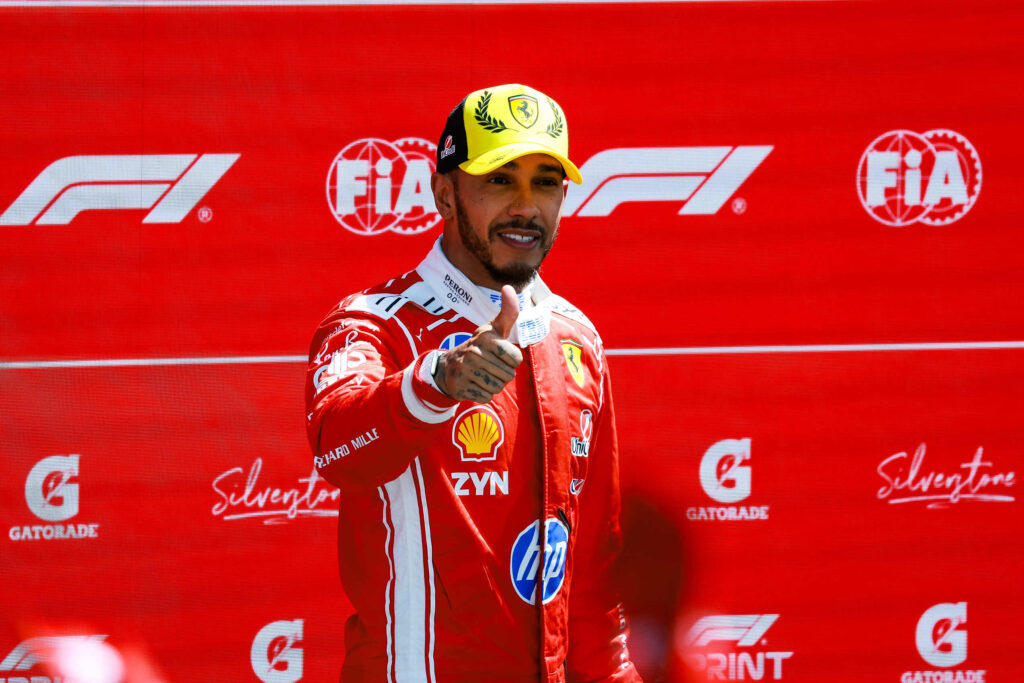
Friday quickly suggested otherwise.
Later that evening, Hamilton added another strong result by snatching Sprint pole from Antonelli by just 0.011 seconds. It was almost the perfect Friday: fastest in practice and first on the grid for Saturday’s Sprint at his home race.
Saturday Sprint: Antonelli refuses to let Hamilton escape
Hamilton kept the lead at the start of the Sprint and defended firmly against Antonelli, but the young Mercedes driver refused to let the Ferrari get away.
Kimi stayed close, lap after lap, never allowing Hamilton to build a safe margin and waiting for his opportunity. It came on lap eight, when Antonelli attacked, moved into the lead and never gave it back.
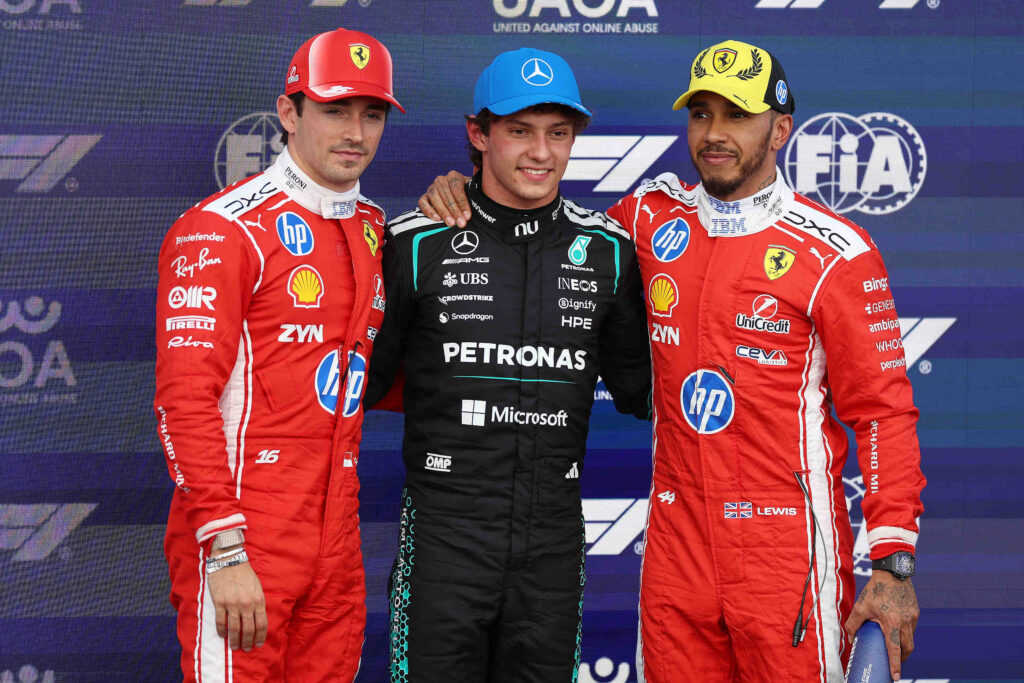
He won by 2.745 seconds, claiming his first Formula 1 Sprint victory. Hamilton finished second, Lando Norris third and Russell fourth. Leclerc was fifth, ahead of Verstappen, Piastri and Lawson.
By then, the weekend was beginning to lean heavily in Antonelli’s direction. He had arrived in Britain as championship leader, won the Sprint and extended his advantage over Russell a little further.
But qualifying was still to come.
Qualifying: Antonelli on pole, with both Ferraris right behind him
On Saturday evening, Antonelli took another step towards what was beginning to look like the perfect weekend.
He led after the opening runs in Q3 and then improved to a 1:28.111, taking his fifth pole position of the season. Leclerc was 0.175 seconds behind, Hamilton qualified third and Russell fourth.
Isack Hadjar was the highest-placed Red Bull driver in fifth. Norris took sixth, Verstappen only seventh, followed by Piastri, Lindblad and Lawson.
For Mercedes, the picture looked almost ideal. Antonelli had been quick all weekend, had won the Sprint and would start the Grand Prix from pole.
But there were two Ferraris alongside him at the sharp end.
And on Sunday, both of them made the better start.
The start: Leclerc takes the lead immediately
Before the race had even begun, there was a small drama involving Fernando Alonso. The Aston Martin briefly stopped on the formation lap before continuing, but the Spaniard was forced to start from the pit lane.
All 22 cars started on the medium tyre, with Pirelli expecting many drivers to be able to complete the race with a single stop.
When the lights went out, Leclerc launched perfectly.
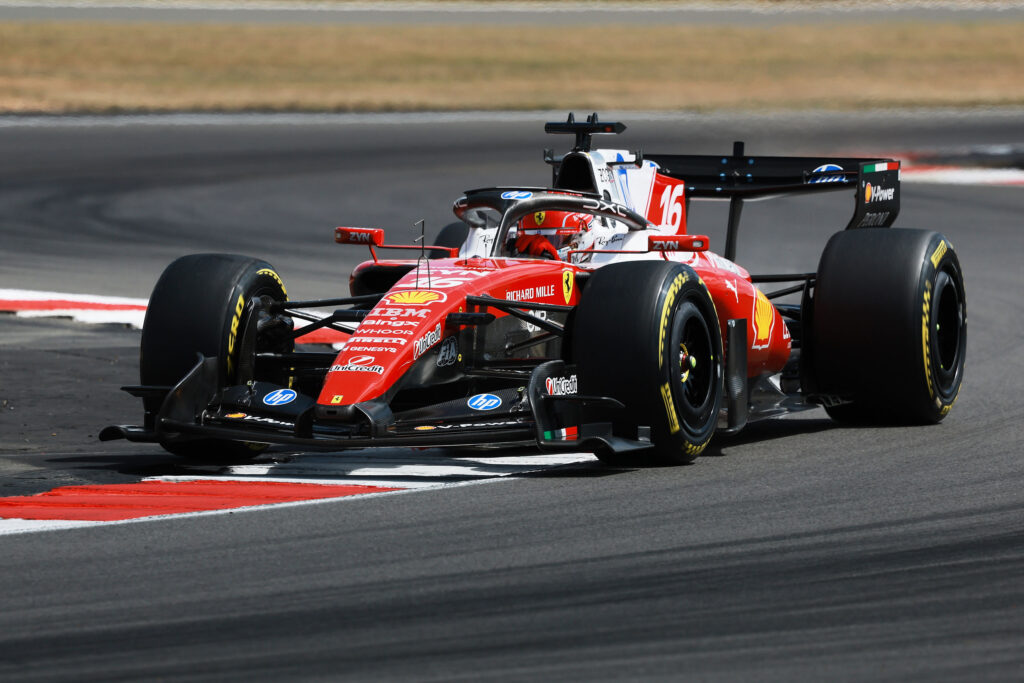
The No.16 Ferrari shot forward and was already ahead of Antonelli at the first corner. Hamilton also got off the line better than the Mercedes and moved into second. Within seconds, the championship leader had fallen from pole to third.
There was trouble behind as well. Piastri suffered front-wing damage after contact with Lawson and had to pit at the end of the opening lap. His race was effectively compromised immediately.
Alex Albon made contact with Oliver Bearman and was handed a 10-second penalty. Verstappen moved up to fifth, with Hadjar and Norris still close behind.
At the front, Leclerc began to build his race.
Hamilton is penalised as Antonelli fights back
Within the opening laps, the stewards announced that Hamilton’s start was under investigation. The decision soon followed: a five-second penalty for a false start.
On track, Antonelli was beginning to recover his rhythm. By lap nine he was right behind Hamilton, and on lap 11 he attacked through Copse to reclaim second place.
Leclerc remained ahead, around four seconds clear.
For Antonelli, the race was beginning to come back to him. After losing ground at the start, he had cleared Hamilton and now had open track in which to chase the Ferrari.
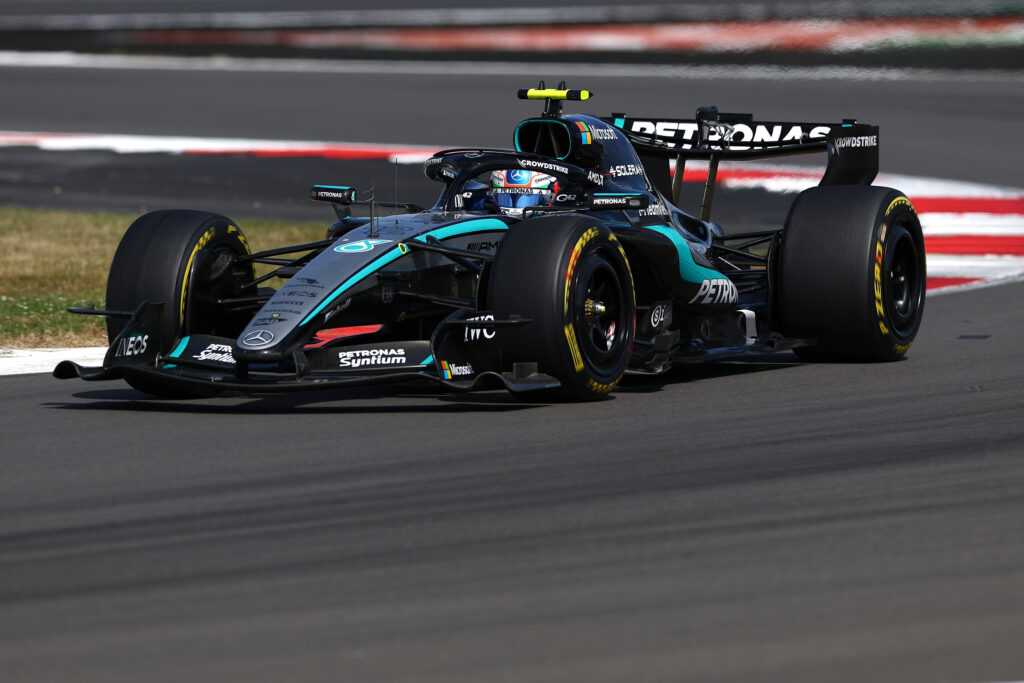
Behind them, Verstappen was closing on Russell. On lap 17, Max passed the Mercedes and immediately pitted for hard tyres.
It was the first major strategic move among the leading group.
Leclerc controls the race as Mercedes leaves Antonelli out
A brief Virtual Safety Car appeared on lap 22 when marshals had to remove an umbrella from the side of the circuit. Among the leaders, only Esteban Ocon and Sergio Perez managed to benefit.
Hamilton stopped shortly afterwards, served his five-second penalty and rejoined in sixth.
Leclerc pitted on lap 26 and switched to the hard tyre. That handed the lead to Antonelli.
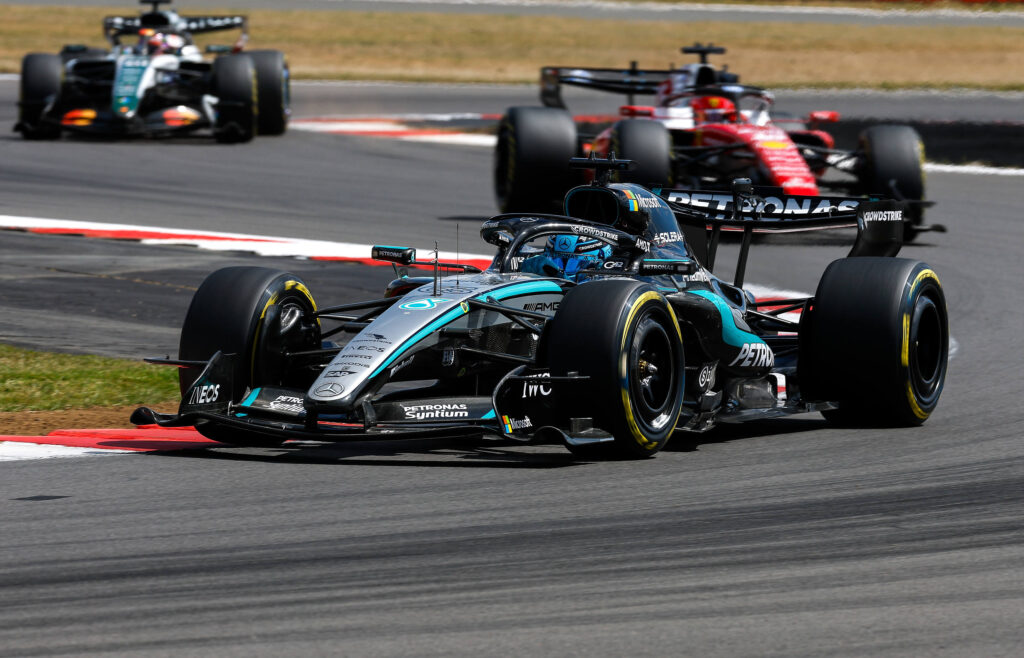
Mercedes chose to extend Kimi’s opening stint. The reasoning was clear: leave him out longer, give him fresher tyres for the final phase and try to attack Leclerc for victory.
On paper, it was an intriguing plan.
Antonelli finally stopped on lap 36 and returned to the track in second, roughly seven and a half seconds behind the Ferrari. But his tyres were significantly fresher.
And Kimi immediately began to close.
Hamilton and Russell give the home crowd a proper fight
While Antonelli continued his long opening stint, Russell and Hamilton delivered one of the best battles of the race.
On lap 30, Lewis attacked and moved ahead, only for George to reclaim the position almost immediately.
A lap later, Hamilton tried again at Brooklands and passed the Mercedes once more. Russell responded at Copse.
Two British drivers, former Mercedes team-mates, exchanged positions through several corners on one of the fastest circuits on the calendar.
Russell’s situation soon became more difficult when Mercedes reported a slow puncture. He had to pit on lap 35 and rejoined only seventh.
At that point, a home podium looked unlikely.
Silverstone was not finished rewriting the script.
Antonelli closes on Leclerc — and then everything falls apart
After his pit stop, Antonelli really did begin to close.
By lap 41, the gap to Leclerc had fallen to 3.1 seconds. The fresher tyres were working, and there was enough of the race remaining to expect a genuine fight for victory.
Then Kimi reported over the radio that something was wrong with the car.
Mercedes called him in and changed the front wing and tyres. At first, the team suspected a problem with the left-front wheel fairing. Antonelli returned to the circuit, but immediately reported that the car would barely turn.
He had to stop again so that the damaged component could be removed.
Within minutes, a weekend that had begun with a Sprint victory and continued with pole position had collapsed. After two additional stops and a five-second track-limits penalty, Antonelli was classified only 16th.
For Leclerc, it meant one thing: his main rival for victory had disappeared.
Ferrari was now in control.
Verstappen crashes as the race ends behind the Safety Car
The race changed again on lap 48.
Verstappen went off at Stowe and became stranded in the gravel, bringing out the Safety Car.
The Dutchman later linked the crash to a rear-wing problem that prevented the wing from fully returning to its normal position, suddenly costing the car downforce. A similar incident had already occurred in Austrian qualifying, although Red Bull clarified that the precise nature of the Silverstone failure was different.
Two dangerous incidents in two consecutive events made the subject one of the team’s main technical concerns.
A final round of pit stops followed. Both Ferraris came in for fresh tyres, while Russell stayed out.
That changed the podium.
George moved up to second ahead of Hamilton. There was no restart, as the marshals were unable to recover Verstappen’s Red Bull before the race distance was completed.
Leclerc crossed the line behind the Safety Car to take his first win of the season. Russell was second. Hamilton third.
Hamilton keeps his podium after a post-race investigation
The story was not completely over at the chequered flag.
Hamilton was investigated for a possible yellow-flag infringement. A time penalty could have handed third place to Norris.
But the stewards issued only a formal reprimand. Hamilton kept third place and his home podium.
For the British crowd, the result was almost perfect: Russell and Hamilton on the podium, Norris fourth.
But the victory was going back to Maranello.
The rest: Norris fourth, no points for Piastri, Bortoleto puts Audi back in the top ten
Norris finished fourth and came close to a podium. Hadjar was fifth, while Racing Bulls enjoyed an excellent weekend, with Lawson and Lindblad finishing sixth and seventh.
Eighth place was particularly important for Gabriel Bortoleto. The Brazilian scored Audi’s first points since the Australian Grand Prix and finally earned a result after several 11th-place finishes.
Franco Colapinto and Pierre Gasly completed the top ten.
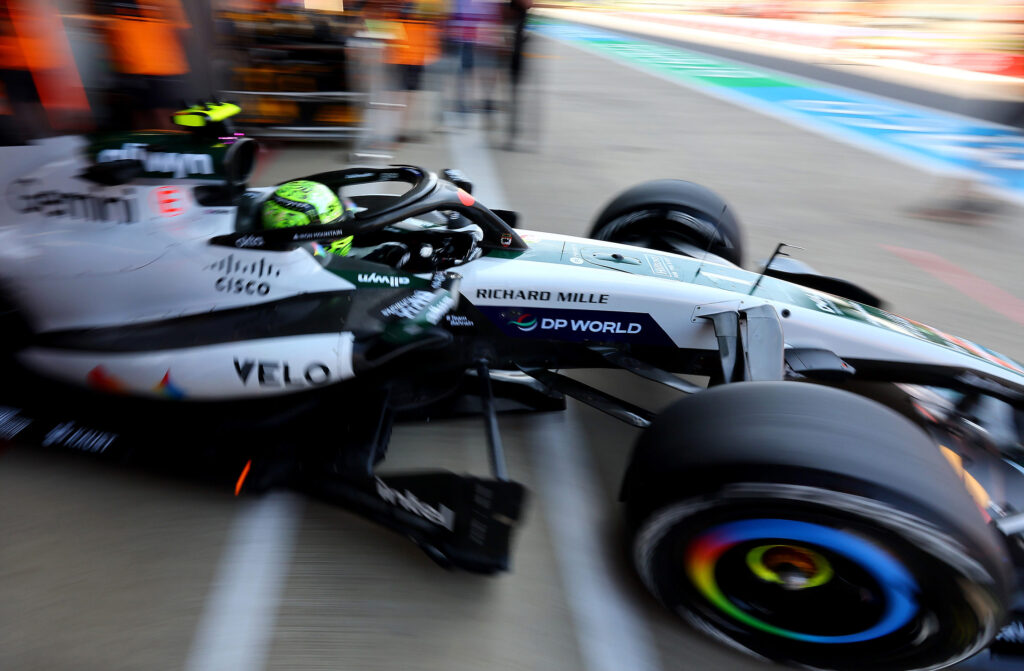
Piastri finished only 11th after suffering damage on the opening lap. For McLaren, it was a frustrating day: Norris collected valuable points, but the second car was effectively out of contention almost immediately.
Williams also endured a difficult race. Carlos Sainz finished 12th and scored no points, while Alex Albon retired after damage sustained in his early contact with Oliver Bearman.
Aston Martin had another tough weekend. Lance Stroll retired with a battery problem, while Fernando Alonso finished only 18th.
British Grand Prix results
| Pos. | Driver | Team | Gap |
|---|---|---|---|
| 1 | Charles Leclerc | Ferrari | 1:27:11.335 |
| 2 | George Russell | Mercedes | +0.427 |
| 3 | Lewis Hamilton | Ferrari | +0.772 |
| 4 | Lando Norris | McLaren | +1.149 |
| 5 | Isack Hadjar | Red Bull | +1.598 |
| 6 | Liam Lawson | Racing Bulls | +2.023 |
| 7 | Arvid Lindblad | Racing Bulls | +2.214 |
| 8 | Gabriel Bortoleto | Audi | +2.413 |
| 9 | Franco Colapinto | Alpine | +3.229 |
| 10 | Pierre Gasly | Alpine | +3.445 |
The race finished behind the Safety Car, so the final gaps do not reflect the true pace difference between the leaders.
Championship: Antonelli’s advantage is cut
For Antonelli, the weekend was almost paradoxical.
He won the Sprint, took pole and looked quick enough to fight for victory on Sunday. But the technical problem left him without points in the Grand Prix.
After Silverstone, Kimi remained championship leader on 179 points. Russell moved to 154 and reduced the gap from 40 points to 25. Hamilton was third on 147.
Leclerc’s victory lifted him to 108 points, with Norris on 97, Piastri on 82 and Verstappen still on 76 after his retirement.
From a championship perspective, Russell was one of the biggest winners of the day. He had not felt quick enough and remained highly critical of his own performance even after finishing second, but he left Silverstone 15 points closer to Antonelli.
The gap between the two Mercedes drivers was now just 25 points.
Around the paddock: Verstappen and McLaren, Ferrari’s upgrade debate and Russell’s concerns
There was plenty to discuss beyond the race itself.
The paddock once again talked about hypothetical interest from McLaren in Verstappen, but there were no confirmed negotiations. Zak Brown publicly stated that he was completely satisfied with the Norris-Piastri pairing and did not consider a driver change to be an immediate issue.
For that reason, the Verstappen story belongs firmly in the category of paddock speculation rather than confirmed transfer talks.
McLaren itself was waiting for a technical step forward. Brown admitted that the team was not yet using the latest specification of the Mercedes power unit and expected further car upgrades. In his view, McLaren should move closer to the front around the summer break.
At Ferrari, there was another discussion taking place. After an aggressive upgrade programme, rival teams questioned how long the Scuderia could continue developing at that rate under the cost cap. Frederic Vasseur responded sharply: there had been no official accusation of a cost-cap breach, and Ferrari, he argued, was not bringing more parts than its rivals.
On track, Leclerc delivered the strongest possible answer.
At Mercedes, the situation was more complicated than Russell’s second place suggested. George himself admitted that he could not fight for the championship with that level of pace, while Toto Wolff later confirmed that Russell still did not feel completely comfortable with the current car.
The irony was that this was precisely the weekend in which George cut Antonelli’s advantage to 25 points. Championships reward not only outright pace, but the ability to remain in the fight when everything is less than perfect.
Conclusion
The 2026 British Grand Prix was a race of missed opportunities and one chance used perfectly.
Antonelli could have completed an ideal weekend. He won the Sprint, took pole and, after his long opening stint, was genuinely closing on Leclerc. But Formula 1 once again showed that there is always one final barrier between a brilliant performance and victory: reliability.
Leclerc left no room for fate to interfere this time. He made a superb start, took the lead immediately, drove with confidence and was ready for Antonelli’s pressure for as long as the Mercedes remained healthy. After difficult weekends in Monaco, Barcelona and Austria, this victory mattered enormously.
Hamilton produced a strong home weekend: fastest in practice, Sprint pole, second in the Sprint and third in the Grand Prix. The false-start penalty prevented him from playing a bigger role in the fight for victory, but the British crowd still got the moment it had been waiting for — Lewis Hamilton on the Silverstone podium in Ferrari red.
Russell finished second despite being unhappy with his own speed. That, perhaps, is one of the defining qualities of a championship campaign: even a difficult weekend by your own standards has to be turned into serious points.
Verstappen suffered another car problem, and Red Bull now has to investigate its rear wing thoroughly. Two dangerous incidents in two consecutive events, even if caused by different types of failure, can no longer be dismissed as coincidence.
And Silverstone once again showed why it remains one of Formula 1’s great places. Here, you can win the Sprint and take pole, only to leave Sunday without a point. You can feel slower than your team-mate and still suddenly finish second. You can take a penalty, fight through several great battles and still stand on your home podium.
And you can arrive after several difficult races with little certainty — and leave as a winner.
That is exactly what Charles Leclerc did.

