

The 2026 Catalan Grand Prix at the Circuit de Barcelona-Catalunya became one of the most dramatic and bruising rounds of the MotoGP season. The weekend began as a classic Spanish showdown, with Alex Marquez, Pedro Acosta, Jorge Martin and Marco Bezzecchi all looking capable of playing a major role. By Sunday afternoon, however, the tone had changed completely. Fabio Di Giannantonio’s victory was a major sporting achievement, but the defining story of the Grand Prix was the sequence of heavy crashes, two red flags, the injuries suffered by Alex Marquez and Johann Zarco, and a final classification reshaped by penalties.
This was not simply a chaotic race weekend. It was a reminder of how narrow the line remains in MotoGP between a fight for victory and serious danger. On one side, there was Di Giannantonio’s win, Fermin Aldeguer’s podium and Francesco Bagnaia’s return to the top three. On the other, there was Alex Marquez’s crash following Pedro Acosta’s technical problem, Zarco’s heavy fall after the restart, and renewed questions over how races should be managed after major accidents.
Friday: Alex Marquez Sets the Early Pace
Friday in Barcelona belonged largely to Alex Marquez. From the opening runs, the Spaniard looked comfortable and quickly found a strong balance on a circuit where long-radius corners, rear-tyre management and precision on corner exit are crucial. For Marquez, this was not just a home Grand Prix. It was one of those weekends where he immediately looked like a genuine contender for victory.
Behind him, the picture was less settled. Jorge Martin began the weekend with a worrying run of crashes, while Aprilia did not look like a team fully in control of the situation. Marco Bezzecchi remained consistent in terms of championship management, but on pure speed he did not appear untouchable. Pedro Acosta, by contrast, gradually made it clear that KTM had the pace in Barcelona not only to fight for a podium, but potentially for the win.
Friday set the tone for the entire weekend: Marquez was fast, Acosta was building momentum, Ducati retained strength in depth, and Aprilia risked losing too much ground on a weekend where championship stability mattered.
Saturday: Acosta Takes Pole, Alex Marquez Wins the Sprint
Qualifying was Pedro Acosta’s moment. The young Spaniard claimed pole position with a lap of 1:38.068, putting KTM at the head of the grid. It was more than just a fast lap: Acosta showed he had the speed to lead a race, not merely attack from the chasing pack.
The front row was formed by Pedro Acosta, Franco Morbidelli and Alex Marquez. That order alone promised an intense fight. Acosta had the one-lap pace, Morbidelli had a major opportunity to deliver a strong result for VR46, and Marquez, starting alongside the leaders, remained one of the clear favourites for the Sprint.
The Sprint delivered exactly the kind of race the Catalan crowd had hoped for: fast, tense and decided in the final metres. Acosta held a strong pace, but Alex Marquez gradually closed in and forced the fight all the way to the line. The gap between them at the finish was just 0.041 seconds. Marquez took victory, Acosta finished second, and Fabio Di Giannantonio completed the podium.
For Marquez, this was an important psychological win. He did not simply win the short race; he showed that he could absorb Acosta’s pressure, manage the tyres and attack when the risk was at its highest. For Di Giannantonio, third place was the first sign that he could also be a factor in the main race.
MotoGP Sprint Results
| Pos. | Rider | Team / Bike | Gap |
|---|---|---|---|
| 1 | Alex Marquez | Gresini Ducati | 20:02.258 |
| 2 | Pedro Acosta | Red Bull KTM | +0.041 |
| 3 | Fabio Di Giannantonio | VR46 Ducati | +0.457 |
| 4 | Raul Fernandez | Trackhouse Aprilia | +2.928 |
| 5 | Johann Zarco | LCR Honda | +4.764 |
| 6 | Francesco Bagnaia | Ducati Lenovo | +4.894 |
| 7 | Franco Morbidelli | VR46 Ducati | +6.175 |
| 8 | Ai Ogura | Trackhouse Aprilia | +6.871 |
| 9 | Marco Bezzecchi | Aprilia Racing | +7.381 |
| 10 | Enea Bastianini | Tech3 KTM | +7.869 |
Sunday: A Grand Prix That Had to Restart Twice
Sunday’s race was expected to continue the duel between Acosta and Alex Marquez, but it quickly turned into one of the most nervous races of the season. Acosta made a strong start and stayed in front, but the pack behind him remained uncomfortably tight. Raul Fernandez, Alex Marquez, Fabio Di Giannantonio, Jorge Martin and others were constantly within attacking range, where one mistake could easily trigger contact.
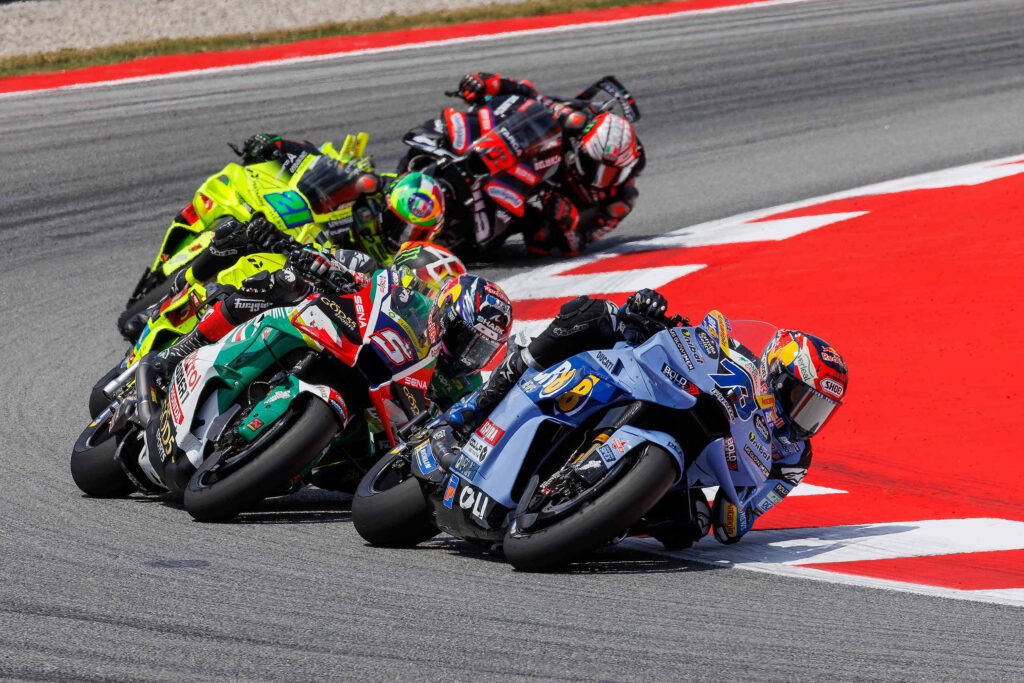
The opening laps were run at a high pace. Acosta tried to control the race, Marquez stayed within striking distance, and the group behind them fought over positions while managing tyre temperature and rear grip. Under normal race conditions, this could have built towards a thrilling final-lap battle. But on lap 12, the sporting narrative abruptly ended.
Alex Marquez’s Heavy Crash
The defining crash of the race came on lap 12. Pedro Acosta was running ahead when his KTM suddenly lost speed due to a technical problem. Alex Marquez was directly behind him and had almost no time to react. At high speed, he hit the back of Acosta’s bike, badly damaging his Ducati and launching himself into a heavy crash.
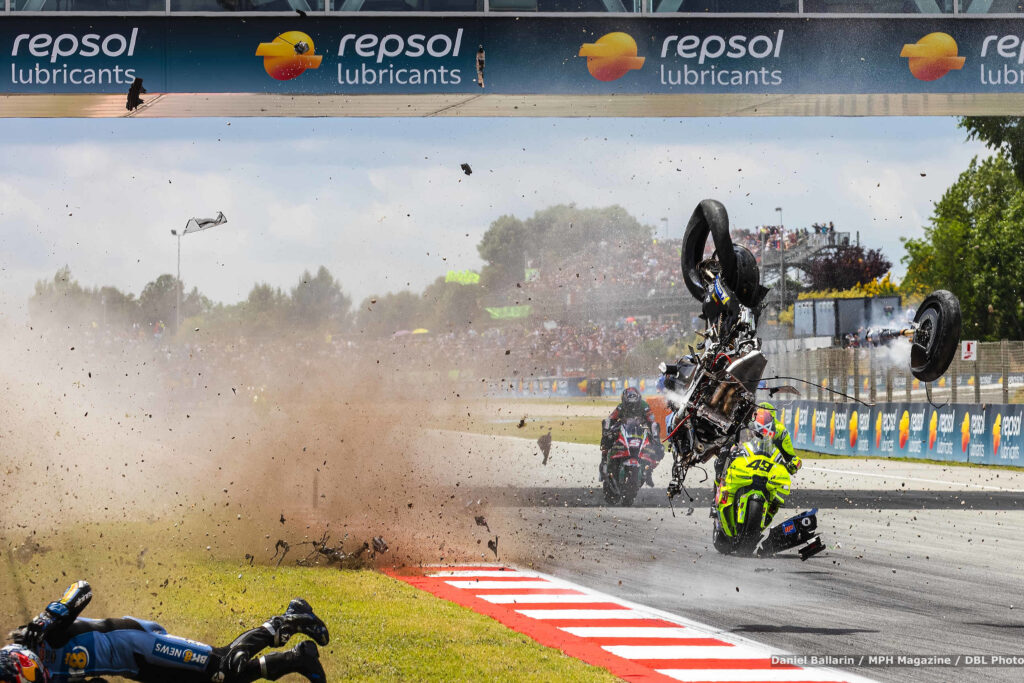
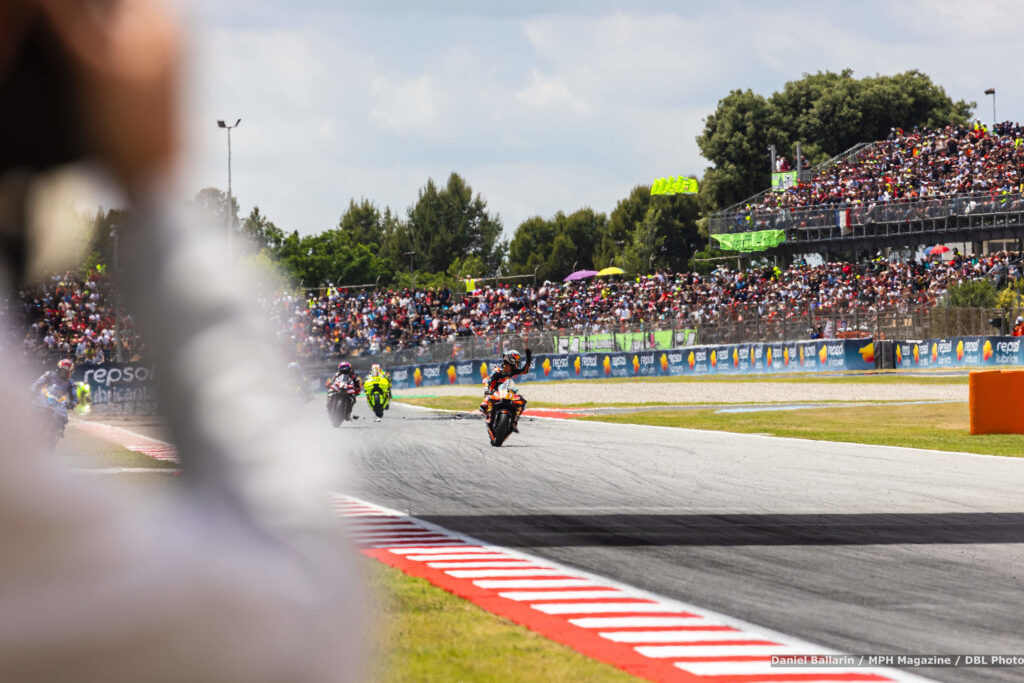
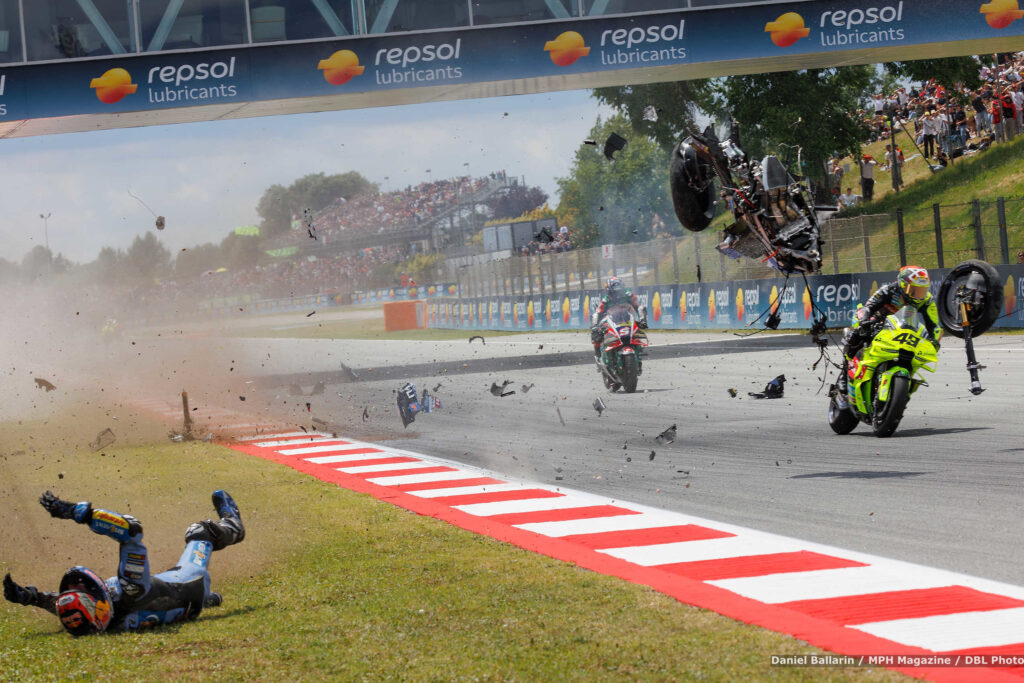
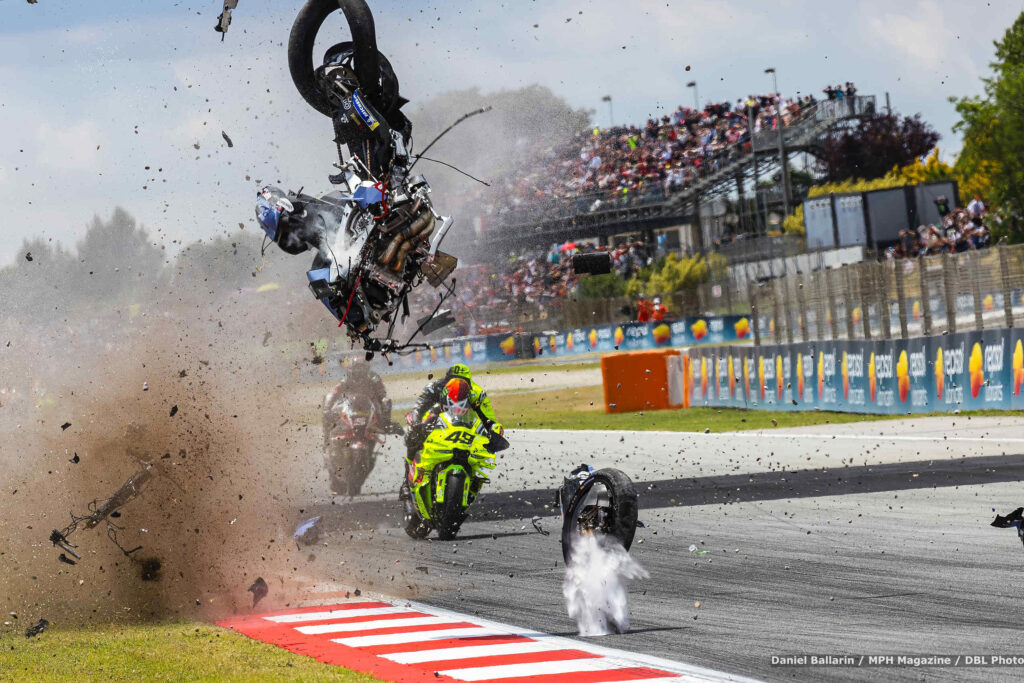
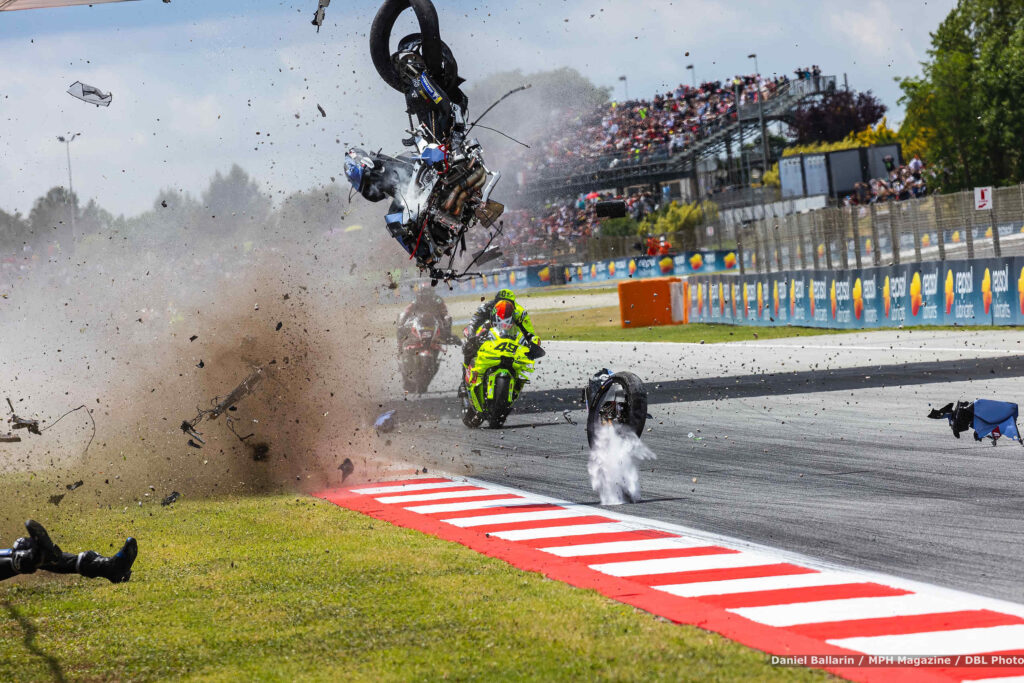
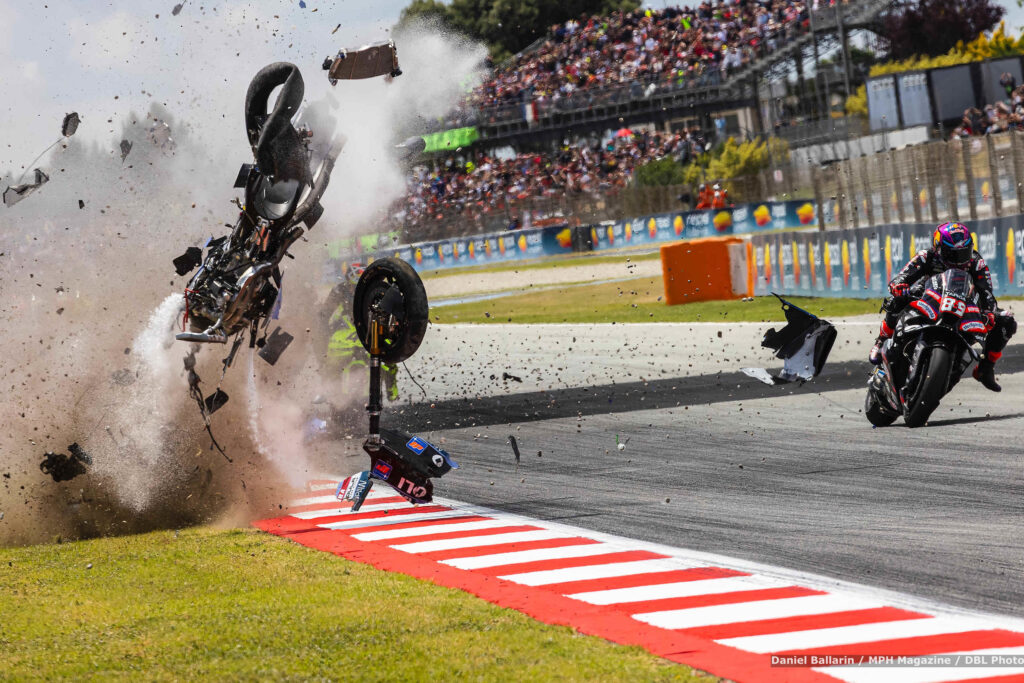
It was a frightening fall. Marquez ended up in the gravel, debris was scattered across the circuit, and other riders had to avoid pieces of machinery and loose wheels. Fabio Di Giannantonio was also caught up in the aftermath, and the race was immediately stopped with a red flag.
Crucially, this was not a simple riding error by Marquez. He found himself behind a bike that suddenly slowed on a fast part of the circuit. In such circumstances, the following rider has almost no margin to rescue the situation: the gap is minimal, the speed is high, and the line has already been committed. That is what made the crash so alarming. It was not a conventional front-end fall or a racing contact in a corner, but a collision with a machine that had sharply lost speed directly ahead.
Marquez was conscious, but he was taken to hospital for detailed checks. He was later diagnosed with a fractured right collarbone and a small fracture in the area of the seventh cervical vertebra. His collarbone was operated on and fixed with a plate. After surgery, he was discharged from hospital, but his recovery required time away from racing, with Gresini confirming that he would miss the following rounds in Italy and Hungary.
Given the severity of the crash, Marquez’s condition could be described as stable, but the injuries were still serious. A collarbone fracture is already a painful and restrictive injury for a motorcycle racer, while any damage in the cervical spine area demands particular caution. Even after a successful operation, returning to MotoGP after such a crash cannot be treated as a simple formality. A rider has to recover mobility, strength, body control and confidence after a high-speed impact.
Zarco’s Crash After the Restart
After the first red flag, the race was restarted, but the new start almost immediately produced another heavy crash. In the first corner, Johann Zarco, Luca Marini and Francesco Bagnaia were involved in a violent accident. The pack arrived at the corner tightly bunched, on cooler tyres and with very little space between the riders. In that situation, the smallest change of line or a slightly late braking move can turn a normal fight for position into a multi-rider crash.
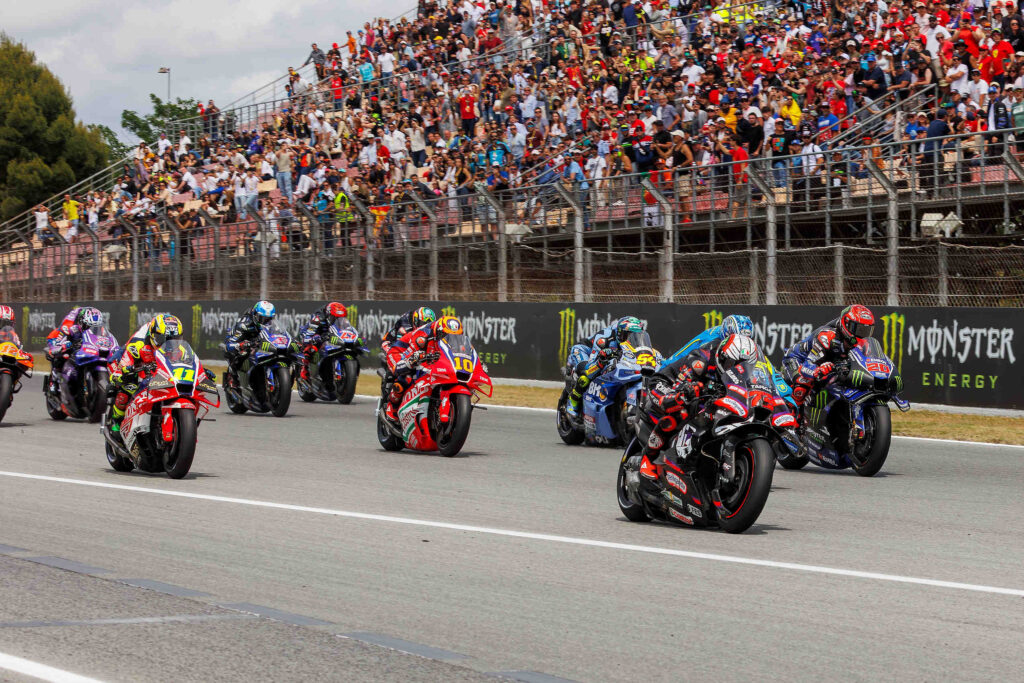
Zarco came off worst. After falling, his leg became trapped near Bagnaia’s bike, and the Frenchman was dragged through the gravel. That made the crash especially dangerous. When a rider does not separate cleanly from the motorcycle, the gravel trap does not work in the usual way, and the body can be subjected to additional twisting forces and impacts.
Medical checks later revealed knee ligament damage, an injury to the medial meniscus and a small fracture around the ankle area. Zarco was discharged from hospital and then travelled to France to see a knee specialist for further assessment and to decide on the next stage of his recovery.
This crash highlighted a different kind of MotoGP risk. Whereas Marquez’s accident was caused by a sudden technical problem ahead of him, Zarco’s crash came from a classic restart scenario: a compressed field, the first corner, cooler tyres, aggressive braking and almost no spare room. On paper, such moments look like a normal part of racing. In reality, they often produce the most painful consequences.
The Final Restart: Di Giannantonio Keeps His Head
After the second red flag, the race was reduced to 12 laps. In effect, this was the third version of the Catalan Grand Prix. The original rhythm had disappeared, tyre strategy had become almost irrelevant, and the psychological pressure on the riders had increased sharply. Under those conditions, it was not enough simply to be fast. The riders also had to keep their focus after two major crashes.
Acosta was again at the front and initially looked like the main contender for victory. But as the shortened race developed, his pace began to fade. Fabio Di Giannantonio, by contrast, built his race intelligently. He did not force the issue too early, picked off rivals as the laps unfolded, and reached Acosta at exactly the right moment.
With three laps remaining, Di Giannantonio attacked and took the lead. That was the decisive move of the race. Once in front, he did not allow his rivals to immediately respond and controlled the run to the flag. For VR46, it was a particularly important victory: not just a podium, but a full Grand Prix win on a day when chaos could have destroyed any race plan.
Fermin Aldeguer finished second and delivered an emotionally important result for Gresini after Alex Marquez’s crash. Francesco Bagnaia took third, even though his pace had not looked especially convincing for much of the weekend. For him, this podium was more a rescue of a difficult Grand Prix than a statement of dominance.
Further drama came after the finish. Joan Mir had initially crossed the line in a podium position, but he received a 16-second penalty for a tyre pressure infringement and dropped down the order. Ai Ogura was also penalised after contact with Acosta on the final lap. As a result, the final classification looked significantly different from the order seen immediately after the chequered flag.
Final MotoGP Results After Penalties
| Pos. | Rider | Team / Bike | Gap / Status |
|---|---|---|---|
| 1 | Fabio Di Giannantonio | VR46 Ducati | 20:06.243 |
| 2 | Fermin Aldeguer | Gresini Ducati | +1.466 |
| 3 | Francesco Bagnaia | Ducati Lenovo | +4.320 |
| 4 | Marco Bezzecchi | Aprilia Racing | +4.679 |
| 5 | Fabio Quartararo | Yamaha Factory | +4.876 |
| 6 | Luca Marini | Honda HRC | +4.971 |
| 7 | Brad Binder | Red Bull KTM | +5.137 |
| 8 | Ai Ogura | Trackhouse Aprilia | +5.377 |
| 9 | Diogo Moreira | LCR Honda | +6.839 |
| 10 | Franco Morbidelli | VR46 Ducati | +7.160 |
| 11 | Maverick Vinales | Tech3 KTM | +10.147 |
| 12 | Augusto Fernandez | Yamaha Factory | +16.245 |
| 13 | Joan Mir | Honda HRC | +17.250 |
| 14 | Alex Rins | Yamaha Factory | +22.916 |
| 15 | Jack Miller | Pramac Yamaha | +26.452 |
| DNF | Pedro Acosta | Red Bull KTM | retired after crash |
| DNF | Alex Marquez | Gresini Ducati | crash / injury |
| DNF | Johann Zarco | LCR Honda | crash / injury |
| DNF | Enea Bastianini | Tech3 KTM | retired |
MotoGP: The Sporting Verdict
Di Giannantonio’s victory was no accident. Yes, the race had been broken up by red flags, but in the final segment he was the rider who best kept his composure. He waited, avoided burning through his tyres too early, and attacked at the point when Acosta began to lose momentum. On a day when many strong riders crashed, made mistakes or received penalties, Di Giannantonio did what mattered most: he stayed fast and precise.
Aldeguer delivered a mature ride and took a podium that carried extra meaning for Gresini after Marquez’s crash. Bagnaia salvaged an important result from a difficult weekend. Bezzecchi, finishing fourth, strengthened his championship position, especially given Jorge Martin’s continued problems. Acosta, despite losing the chance of victory, again showed his speed — but Barcelona was a painful reminder that in MotoGP, pace alone is not enough when the bike lets a rider down at the worst possible moment.
Moto2: Manuel Gonzalez Wins at Home
The Moto2 race was far calmer than Sunday’s MotoGP contest, but it had its own tension. Celestino Vietti started from pole and controlled much of the distance. He got away well, settled into a strong rhythm and for a long time looked like the clear favourite for victory.
Manuel Gonzalez played the long game. He did not rush into an early attack, instead gradually reducing the gap while preserving his tyres and waiting for the leader to lose stability. That moment came in the closing laps. Vietti began to look less secure on corner exit, and Gonzalez seized his chance. The Spaniard moved into the lead and held it to the finish.
For Gonzalez, this was an important win not only because it came at home, but because of the way he managed the race. He did not win through chaos; he won through measured pace and precise timing. Vietti finished second, just 0.203 seconds behind, while Izan Guevara took third after a strong ride through the chasing group.
Moto2 Race Results
| Pos. | Rider | Team / Bike | Gap |
|---|---|---|---|
| 1 | Manuel Gonzalez | Liqui Moly Dynavolt Intact GP, Kalex | 36:06.295 |
| 2 | Celestino Vietti | SpeedRS Team, Boscoscuro | +0.203 |
| 3 | Izan Guevara | BLU CRU Pramac Yamaha, Boscoscuro | +4.205 |
| 4 | Ivan Ortola | QJMotor-Frinsa-MSi, Kalex | +6.338 |
| 5 | Daniel Holgado | CFMOTO Aspar, Kalex | +7.971 |
| 6 | David Alonso | CFMOTO Aspar, Kalex | +8.080 |
| 7 | Filip Salac | American Racing, Kalex | +9.636 |
| 8 | Alonso Lopez | Italjet Gresini Moto2, Kalex | +11.312 |
| 9 | Luca Lunetta | SpeedRS Team, Boscoscuro | +13.545 |
| 10 | Senna Agius | Liqui Moly Dynavolt Intact GP, Kalex | +13.761 |
| 11 | Daniel Muñoz | Italtrans Racing Team, Kalex | +14.210 |
| 12 | Jose Antonio Rueda | Ajo Motorsport, Kalex | +15.056 |
| 13 | Barry Baltus | Fantic Racing, Kalex | +16.423 |
| 14 | Aron Canet | Marc VDS, Boscoscuro | +17.667 |
| 15 | Ayumu Sasaki | RW Racing Team, Kalex | +18.721 |
Moto3: Maximo Quiles Wins a Last-Lap Thriller
The Moto3 race once again showed why the lightweight class remains the most unpredictable category on the Grand Prix programme. Barcelona delivered a familiar Moto3 script: a large lead group, constant position changes, hard braking moves and a result decided in the final metres.
Maximo Quiles handled the race with remarkable composure. He did not try to break the group too early, instead making sure he was in the right position for the final lap. In Moto3, that is often more important than outright speed. A rider has to be fast, but also perfectly placed through the final corners and onto the main straight.
The finish was almost a photo finish. Quiles won, with Alvaro Carpe only 0.094 seconds behind. David Muñoz was 0.098 seconds off the win, and Brian Uriarte finished just 0.128 seconds behind the winner. Four riders were covered by little more than a tenth of a second, making Moto3 one of the standout races of the weekend.
For Quiles, the victory further confirmed his status as one of the leading riders of the early season. Once again, he was the sharpest when there was no room left for error.
Moto3 Race Results
| Pos. | Rider | Team / Bike | Gap |
|---|---|---|---|
| 1 | Maximo Quiles | CFMOTO Aspar Team, KTM | 32:28.964 |
| 2 | Alvaro Carpe | Red Bull KTM Factory Racing, KTM | +0.094 |
| 3 | David Muñoz | Liqui Moly Dynavolt Intact GP, KTM | +0.098 |
| 4 | Brian Uriarte | Red Bull KTM Factory Racing, KTM | +0.128 |
| 5 | David Almansa | Liqui Moly Dynavolt Intact GP, KTM | +0.552 |
| 6 | Matteo Morelli | CFMOTO Aspar Team, KTM | +0.581 |
| 7 | Hakim Danish | MT Helmets-MSi, KTM | +0.623 |
| 8 | Veda Pratama | Honda Team Asia, Honda | +0.984 |
| 9 | Adrian Fernandez | Leopard Racing, Honda | +1.011 |
| 10 | Casey O’Gorman | SIC58 Squadra Corse, Honda | +1.151 |
| 11 | Eddie O’Shea | GRYD-MLav Racing, Honda | +5.236 |
| 12 | Valentin Perrone | Red Bull KTM Tech3, KTM | +9.805 |
| 13 | Adrian Cruces | CIP, KTM | +9.853 |
| 14 | Matteo Bertelle | LEVELUP-MTA, KTM | +9.909 |
| 15 | Ryusei Yamanaka | MT Helmets-MSi, KTM | +9.951 |
Weekend Verdict
The 2026 Catalan Grand Prix was a weekend where the sporting results were inevitably pushed into the background. Di Giannantonio won a strong and psychologically demanding MotoGP race, Aldeguer gave Gresini an important podium, Bagnaia rescued a difficult weekend, and Bezzecchi used his rivals’ troubles to strengthen his championship position. In Moto2, Manuel Gonzalez underlined his status as a title contender, while in Moto3 Maximo Quiles once again proved the sharpest rider in the final metres.
But Barcelona will be remembered above all for its crashes. Alex Marquez’s fall after Acosta’s technical problem showed how dangerous a sudden loss of speed can be when a rider is following closely at high velocity. Johann Zarco’s accident after the restart highlighted another kind of risk: a compressed field arriving into the first corner with almost no room for correction.
Catalonia 2026 will therefore stand not only as the day of Di Giannantonio’s victory, but also as a race that forced MotoGP to again confront questions of safety, technical failures and the price of risk in a championship where the fight for fractions of a second can sometimes end in a hospital room.

