

The Austrian Grand Prix rarely needs a long introduction. The Red Bull Ring is too short, too intense and too unforgiving for a slow build-up. Everything happens quickly here: one lap, one attack, tyre overheating, a pit stop, then another chance to change the course of the race.
In 2026, Spielberg followed that familiar pattern once again. There was no artificial chaos and no endless chain of random incidents, but there was a race in which almost every decision carried a price.
George Russell won from pole and claimed his second victory of the season, yet Sunday was far from a comfortable drive in clean air. Max Verstappen started only fifth after crashing in qualifying, fought his way forward and, in the second half of the race, forced the Mercedes leader to keep pushing without any real opportunity to relax. Kimi Antonelli finished third and retained the championship lead, although for once he was not the main story at Mercedes.
Before the race: heat, upgrades and the sense that something was beginning to change
The heat was one of the defining factors of the Austrian weekend. Air and track temperatures climbed to levels that turned tyre and brake management into a race of their own. After the finish, Russell admitted that the conditions had been demanding and that he had needed to push almost every lap, never able to back off properly.
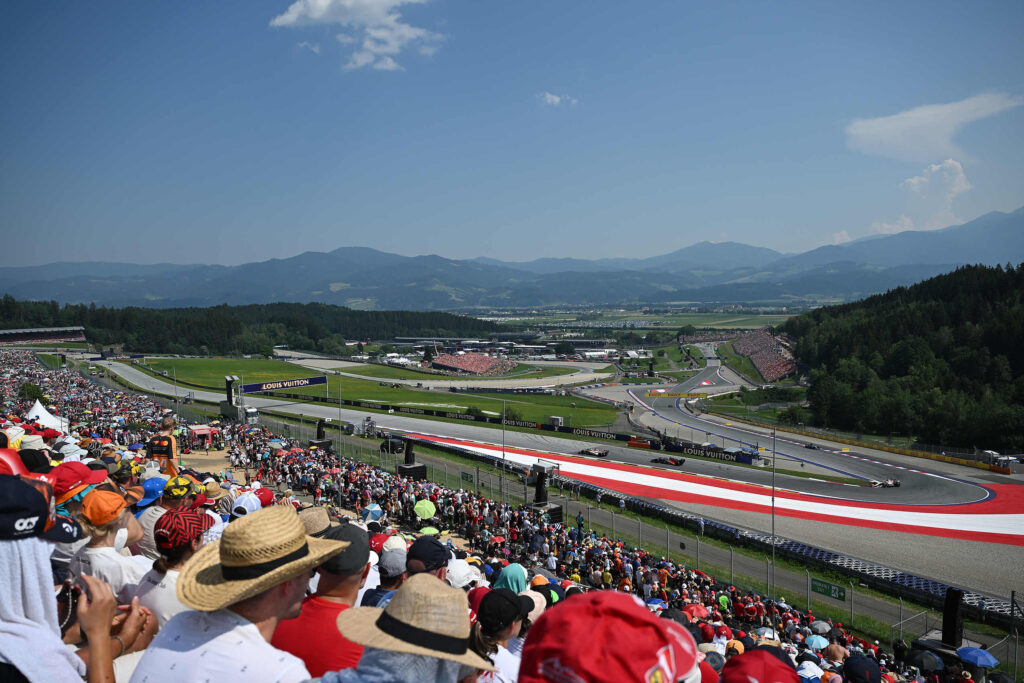
At the short Red Bull Ring, those conditions can be particularly punishing. There is little time for the tyres to recover, the braking zones are heavy, and the repeated accelerations place constant demands on the car. A machine can look perfectly balanced over one lap and then, only a few minutes later, begin to fall outside its ideal operating window.
Several teams arrived with upgrades. Cadillac, in particular, brought a significant package as it continued its effort to move closer to the midfield. But Sunday proved brutally short. Valtteri Bottas stopped after just two laps when his front brakes caught fire, while Sergio Perez retired after four laps with a similar issue. It was the team’s first double retirement of the season.
Red Bull, by contrast, left Austria with a far more encouraging story. After a difficult start to the year, the updated car finally allowed Verstappen to do more than simply rescue a result. For the first time in a long while, he was able to race among the leaders on genuine pace. Second place was the best result of the season so far for both Max and the team.
Practice: Mercedes is quick, but not untouchable
Friday and Saturday morning belonged to Mercedes. Antonelli topped both Friday sessions, while Russell led FP3 by just 0.038 seconds from his team-mate.
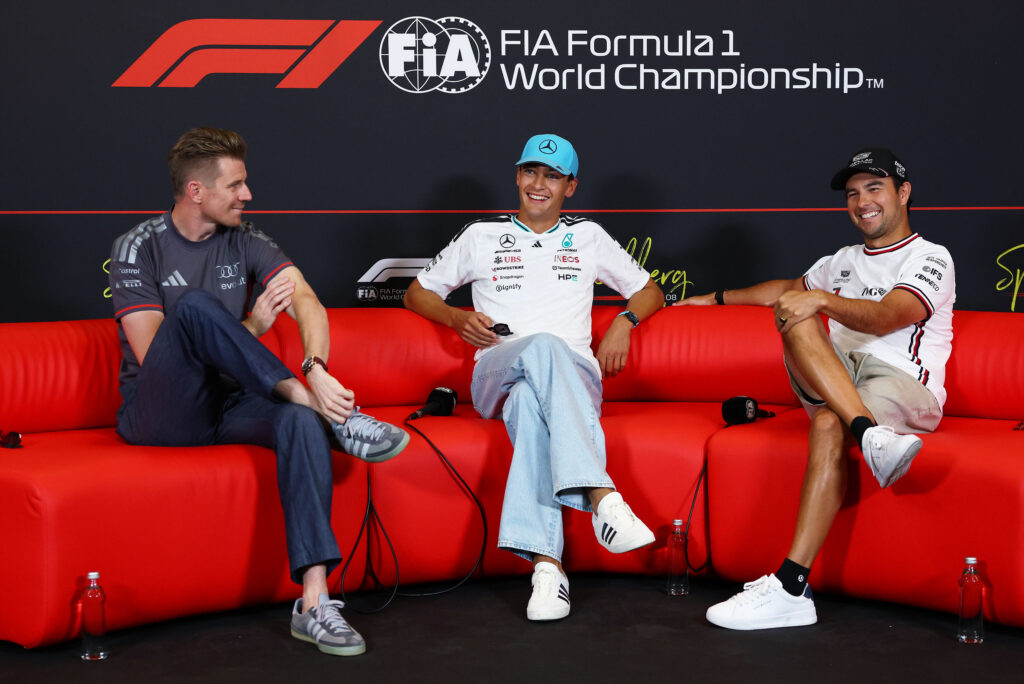
That mattered because Mercedes looked strong not only over a single lap, but also across longer runs. Yet there was no overwhelming advantage. Ferrari remained close, McLaren stayed in the picture, and Red Bull was beginning to find the pace it had been missing.
By Saturday, it was clear that qualifying could become one of the tightest sessions of the season.
And that is exactly what happened.
Qualifying: Russell takes pole as Verstappen crashes
The closing minutes of Q3 were tense. Verstappen lost control of the Red Bull at Turn 9 and crashed, bringing out yellow flags just as Russell was completing his decisive lap.
For several minutes, the question was simple: had Russell slowed down enough?
The stewards found no infringement. His lap stood, and Russell secured pole with a 1:06.113. Charles Leclerc was 0.236 seconds behind, with Lewis Hamilton another 0.059 seconds back in third. Antonelli qualified fourth after aborting his final attempt when he believed the yellow flag situation was more serious than it actually was. Verstappen, despite the crash, held on to fifth.
For Ferrari, starting second and third looked like a genuine opportunity. After Hamilton’s victory in Barcelona, there was once again a feeling around Maranello that the team might be capable of more than occasionally troubling Mercedes.
Sunday quickly showed, however, that Ferrari’s qualifying pace and its race pace still told two different stories.
The start: Russell leads away as Verstappen begins his charge
Russell did the most important thing: he made a clean start and immediately gained the advantage of clean air.
Behind him, Hamilton passed Leclerc to move into second. Antonelli endured a nervous opening lap, running off the track more than once, while Verstappen rapidly climbed to third by passing first Antonelli and then Leclerc.
It was already obvious that Red Bull was genuinely quick.
Max no longer looked like a driver dragging a car beyond its natural limits. In Austria, he had the pace to fight.
On lap 11, Verstappen launched his first attack on Hamilton. He briefly moved ahead, but Lewis fought back and reclaimed the position. Their battle continued after the first round of pit stops, and it was not until lap 22 that Verstappen finally made the move stick and established himself ahead of the Ferrari.
That was a crucial moment in the race. The longer Verstappen remained trapped behind Hamilton, the more Russell could extend his advantage. Once Max had clean air, the real chase began.
Ferrari begins to lose the race
Hamilton was the first of the leaders to pit, stopping on lap 13. Leclerc followed shortly afterwards. Ferrari switched to the hard tyre earlier than Mercedes and Red Bull, and gradually it became clear that the team was no longer attacking the race but trying to contain the damage.
For Leclerc, Sunday became a long retreat. He had started second, yet steadily lost both places and pace. In qualifying, Ferrari had been quick enough to dream about victory. Over a long stint, in the heat and on an overheated track, the car proved far more vulnerable.
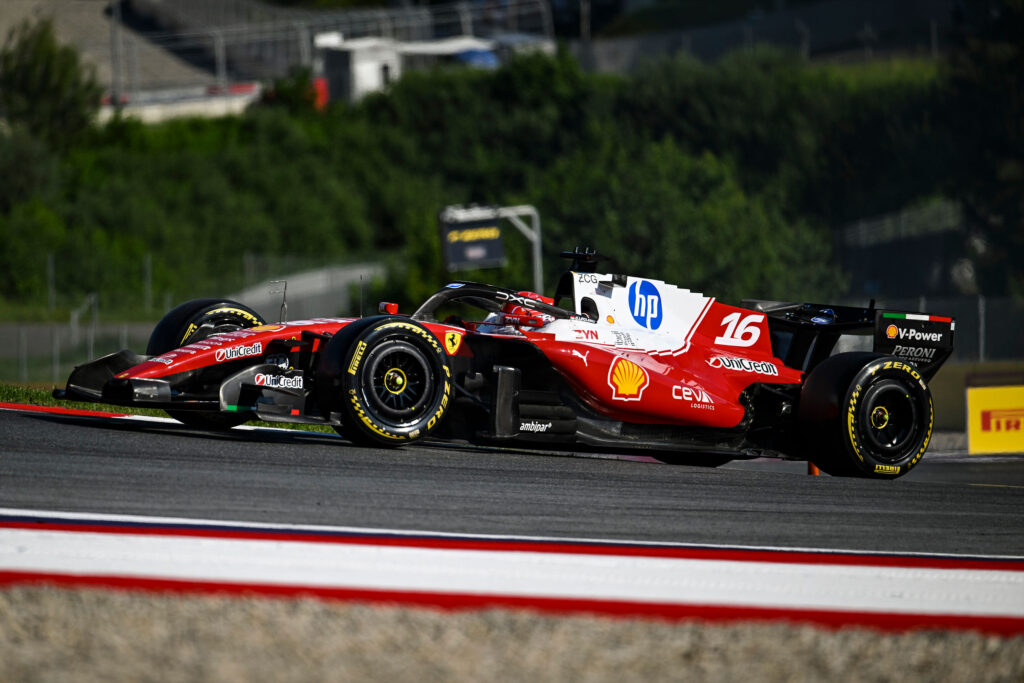
Hamilton coped better. He fought Verstappen, regained track position after the early pit stop, but eventually also dropped out of podium contention.
Fifth place for Lewis and eighth for Leclerc looked particularly disappointing after they had started second and third. Ferrari’s second half of the race became an exercise in defence, with both strategy and pace gradually working against the team.
The middle phase: Verstappen closes in
After the first round of stops, Russell remained in front, but Verstappen slowly began to reduce the gap.
By lap 35, the margin was down to 3.3 seconds. Soon it was closer to two seconds, and by lap 42 Verstappen was only 1.2 seconds behind.
For the first time, a Mercedes victory no longer looked secure.
Russell was the first to make his second scheduled stop, coming in on lap 44 for another set of hard tyres. Red Bull kept Verstappen out for five more laps, hoping the fresher rubber would give him an advantage in the final phase.
When Max finally stopped, he returned to the track roughly ten seconds behind Russell.
Antonelli extended his own stint until lap 52. For a short time, he led the Grand Prix, but after making his stop he rejoined in third just before a brief Virtual Safety Car period caused by debris from a damaged bollard.
The finish: Russell holds off Max as Antonelli almost gets there
The final laps were less about wheel-to-wheel action and more about sustained pressure.
Russell could not afford to ease off. Verstappen was gradually taking seconds out of the lead. At the same time, Antonelli was closing rapidly on the Red Bull.
With five laps remaining, Max was 3.7 seconds behind Russell. With two laps to go, Antonelli was less than a second from Verstappen. By the last lap, the gap between them had fallen to around half a second.
But there was no time left.
Russell won by 1.611 seconds. Verstappen held on to second, with Antonelli finishing just 0.375 seconds behind the Red Bull.
For Russell, it was his second victory of the season and the seventh of his Formula 1 career. After several races in which Antonelli had taken much of the attention, George offered an important reminder: the story inside Mercedes is not yet about one driver alone.
For Verstappen, second place mattered too. Max is hardly the kind of driver who celebrates silverware for finishing runner-up, but after a difficult opening phase of the season, Austria was the clearest evidence yet that Red Bull might finally be capable of running with the leaders again.
McLaren, Ferrari and the rest
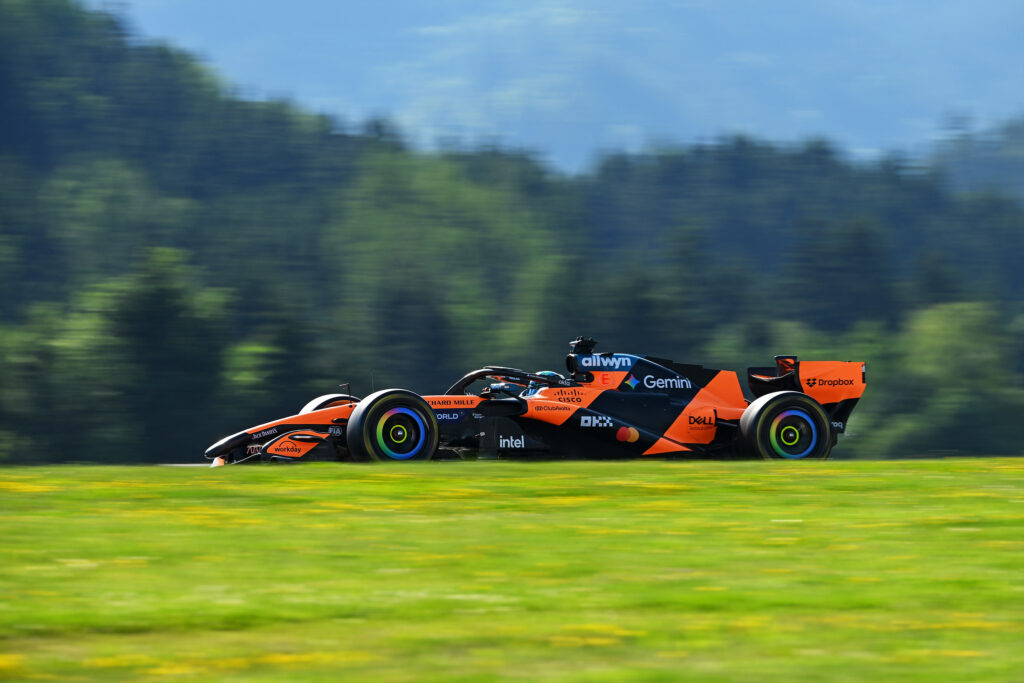
Oscar Piastri finished fourth and delivered McLaren’s best result of the day. The team did not quite have enough to fight for the podium, but once again collected a solid haul of points.
Lando Norris finished seventh after passing Leclerc late in the race. For McLaren, this was not a breakthrough weekend, but a useful one: both cars inside the top ten and no major losses.
Isack Hadjar finished sixth, completing a very strong day for Red Bull. Alongside Verstappen’s second place, it was an important result for the team, with both cars inside the top six.
Liam Lawson and Arvid Lindblad gave Racing Bulls a double points finish in ninth and tenth respectively.
Aston Martin endured another difficult round. Lance Stroll retired with a battery problem, while Fernando Alonso finished only 18th. Williams also lost one car when Carlos Sainz stopped on the main straight with a suspected electrical failure.
Race results
| Pos. | Driver | Team | Gap |
|---|---|---|---|
| 1 | George Russell | Mercedes | 1:26:37.979 |
| 2 | Max Verstappen | Red Bull | +1.611 |
| 3 | Kimi Antonelli | Mercedes | +1.986 |
| 4 | Oscar Piastri | McLaren | +21.809 |
| 5 | Lewis Hamilton | Ferrari | +26.393 |
| 6 | Isack Hadjar | Red Bull | +29.399 |
| 7 | Lando Norris | McLaren | +31.505 |
| 8 | Charles Leclerc | Ferrari | +45.659 |
| 9 | Liam Lawson | Racing Bulls | +1 lap |
| 10 | Arvid Lindblad | Racing Bulls | +1 lap |
Championship: Antonelli stays ahead, Russell moves closer
After Austria, Kimi Antonelli retained the championship lead with 171 points. Russell’s victory moved him back into second on 131, cutting the gap to 40 points. Hamilton was third with 125.
Behind them, Piastri had 80 points, Norris and Leclerc were tied on 79, while Verstappen had 73.
Mercedes remained the team around which the season was being shaped. But Austria showed for the first time in a while that Red Bull did not need to wait for someone else’s mistake to put Mercedes under pressure. It could do so through its own pace.
Around the paddock: Verstappen’s future, Cadillac and the stories beyond the track
The main topic after the race was Red Bull. Verstappen’s second place did not solve all of the team’s problems, but it changed the atmosphere around the project.
While Red Bull had been far from victory, speculation about Max’s future had grown louder. There were reports of possible interest from McLaren, but Zak Brown publicly made it clear that he was satisfied with the team’s current pairing of Norris and Piastri and did not see its driver line-up as an area requiring change.
For that reason, the Verstappen story belongs firmly in the category of paddock speculation rather than confirmed negotiations.
At Cadillac, the mood could hardly have been more different. The team arrived with a major upgrade package and hoped to move closer to the midfield, only for reliability to destroy the weekend before the race had properly begun. Bottas and Perez both retired within four laps with brake-related problems, and Perez admitted afterwards that the team simply could not afford to keep suffering failures of that kind.
That contrast was one of the clearest stories of Austria. Red Bull found evidence that its upgrades might bring it back towards victories. Cadillac received another reminder that speed only matters when a car reaches the finish.
Conclusion
The 2026 Austrian Grand Prix did not turn the championship upside down, but it changed the mood around it.
Mercedes won again, yet for the first time in a long while Red Bull was there not as an accidental visitor to the podium fight, but as a genuine opponent.
Russell delivered an excellent weekend. He took pole in a tense qualifying session, made a clean start, absorbed the pressure and never allowed Verstappen to get close enough to attack. It was not the wildest or most spectacular victory of the year, but it was one of the most complete.
Antonelli retained the championship lead, but the weekend was a reminder that the battle inside Mercedes is far from over. Russell is still there, and he is closer again.
Verstappen did not win, but second place was perhaps Red Bull’s biggest reason for optimism all season. After crashing in qualifying and starting fifth, he fought his way back and crossed the line just 1.611 seconds behind the winner.
Ferrari was given another painful reminder of its weaknesses. McLaren collected points. Racing Bulls took its opportunity. Cadillac once again discovered just how unforgiving Formula 1 can be to a new team.
Austria left one clear impression: this is still Mercedes’ season, but it no longer looks like a solo run. If Red Bull has genuinely found the right development direction, the second half of the year could be far closer than it seemed only a few weeks ago.

