
The Sonsio Grand Prix on the Indianapolis Motor Speedway road course became one of the most intense rounds of the opening part of the 2026 IndyCar season. On paper, the weekend belonged to Alex Palou: he was quick in practice, took pole position and looked like the clear favorite. But in the race, outright pace was not enough. Strategy, pit-stop timing and the ability to survive a sequence of restarts proved decisive. Christian Lundgaard of Arrow McLaren claimed victory, David Malukas finished second, and Graham Rahal completed the podium. Palou recovered to fifth after the race turned against him, but still retained the championship lead.
Friday: Palou Sets the Pace
The weekend began with a clear statement from Alex Palou. The Spaniard topped both practice sessions and immediately established himself as the driver to beat. The Chip Ganassi Racing car looked stable and fast over longer runs, while Palou once again showed why the Indianapolis road course suits him so well.
The schedule, however, was disrupted by rain on Friday, forcing qualifying to be moved to Saturday morning. That made race day more compressed and demanding, leaving teams with little time between qualifying, final preparations and strategic decisions for the 85-lap race.
Behind Palou, several potential contenders were already emerging. Christian Lundgaard stayed close to the front, David Malukas showed solid pace, and the Rahal Letterman Lanigan Racing cars also looked competitive. It was already clear that if the favorite made a mistake, or if the race became chaotic, there would be no shortage of drivers ready to take advantage.
Saturday Qualifying: A Commanding Pole
In qualifying, Palou confirmed his status as the favorite. He took pole position with authority and secured the best possible starting place for the race. His advantage over the rest of the field was significant, and a third consecutive pole at this event only strengthened the impression that he had the weekend under control.
Pato O’Ward joined him on the front row, with Felix Rosenqvist, Christian Lundgaard, David Malukas and Louis Foster lining up behind. That grid order kept Lundgaard and Malukas firmly in contention: they were not the obvious favorites, but they were close enough to benefit from any strategic shift or disruption.
For Kyle Kirkwood, one of Palou’s main championship rivals, qualifying was more difficult. Starting ninth meant he would have to make progress in traffic and rely on the race coming back to him.
Saturday Race: Chaos from Turn 1
Palou held the lead at the start, but the race never settled into a clean rhythm. A major incident broke out in Turn 1 involving Pato O’Ward, Scott Dixon, Felix Rosenqvist and Caio Collet. The field quickly stretched out, several drivers lost ground, and teams were forced to rethink their strategies almost immediately.
In the opening laps, it still looked as though Palou could bring the race back under control. He maintained strong pace, while Kirkwood moved forward and climbed to second. But the key moment came on lap 22, when Alexander Rossi’s car stopped and triggered a caution.
Several drivers had already managed to pit before the neutralization, while Palou and Kirkwood stayed out. When they stopped later, both rejoined in the middle of the pack. For Palou, that was the turning point of the race: instead of controlling the field from clean air, he was now stuck in traffic, exposed to restarts and forced to recover lost ground.
The Turning Point: Lundgaard and Malukas Move Ahead
While Palou fought his way back through the field, the battle for victory shifted to the drivers who had landed in the right strategic window. David Malukas produced a strong middle stint and led for a significant part of the race. He looked composed, managed his pace well and had a genuine chance to take his first IndyCar victory.
But Lundgaard stayed within reach. Arrow McLaren timed his final pit stop well, giving the Dane the opportunity to attack in the decisive phase of the race. His key move came on lap 68: after running side by side with Malukas through several corners, Lundgaard found the space he needed and took the lead.
From that point on, he gave his rivals no real chance to respond. Lundgaard controlled the closing laps and won by almost five seconds. It was the second IndyCar victory of his career and his first since 2023 — an important result both for the driver and for Arrow McLaren.
Finish: Palou Saves Points, but McLaren Takes the Win
At the finish, Lundgaard was a deserved winner, Malukas took second, and Graham Rahal completed the podium. Josef Newgarden finished fourth, ahead of Palou, who recovered from his mid-race setback to score valuable points.
For Palou, it was a race of missed opportunity. He had been the fastest driver for most of the weekend, but the strategic split under caution cost him control of the race. Even so, the Spaniard again showed one of the strengths of his season: even on a difficult day, he was able to limit the damage and keep his championship lead intact.
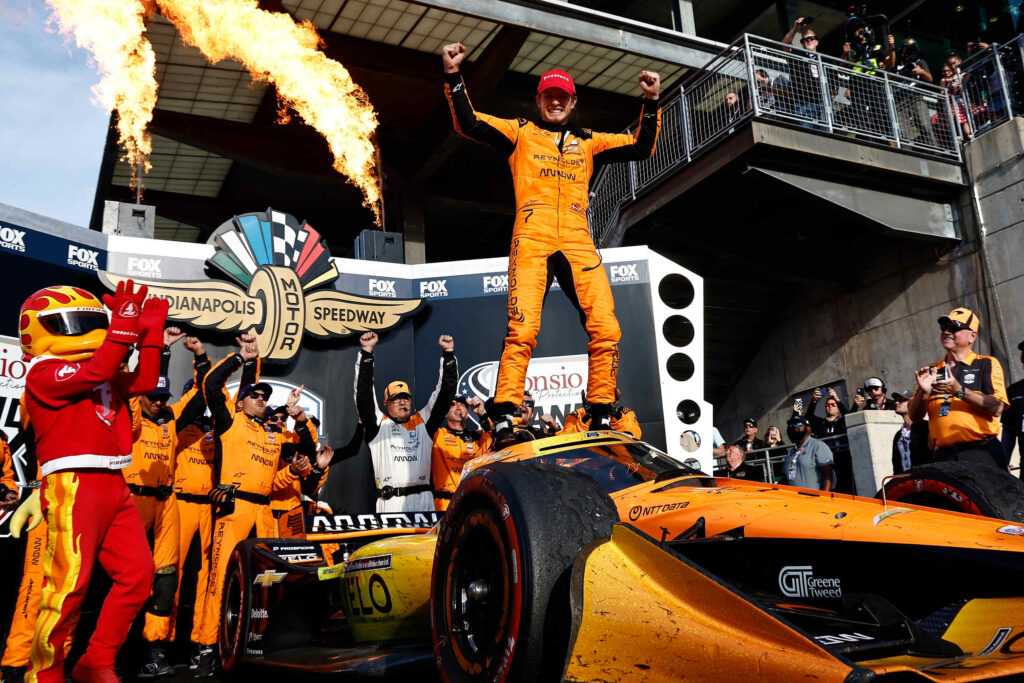
Malukas, despite missing out on victory, delivered one of the most convincing drives of his IndyCar career. Rahal underlined the strength of his team on the Indianapolis road course, while Newgarden gave Penske an important result after a complicated weekend. Dennis Hauger also deserves mention after finishing inside the top 10 and ending the race as the best-placed rookie.
Conclusion: Precision Beats Pure Speed
The 2026 Sonsio Grand Prix was a race where speed mattered, but strategy decided the outcome. Palou controlled the weekend until the middle of the race, only for caution periods and pit timing to reshape the order. Lundgaard was in the right place at the right time, but his win was no accident: he had the pace, absorbed the pressure and made the decisive pass on Malukas when it mattered most.
The race was a vivid opening act to the main part of May at Indianapolis. It showed that even with Palou in strong form, the IndyCar season remains open — and that a single pit stop, one restart and one perfectly executed overtake can decide everything.

